Every spring the same thing happens. The first warm sunshine, the balcony suddenly feels bigger, and the promise: this year I’ll put plants out. You buy three pots and line them up along the railing. By July half have dried out, and the other half are taking space from the little table.
A vertical garden on the balcony works if you check three things before buying: hours of direct sun (at least 4 for herbs), weight (a 9-pot system with wet soil weighs about 15–20 kg) and wind. Indoors, place it within 1–1.5 m of a bright window and use pots with a water reservoir. Choose plants by exposure and give each its own pot.
A vertical garden on the balcony solves exactly this: it moves the plants upwards and frees up the floor. But it only works if you respect three things that almost nobody checks before buying: hours of sun, weight and wind. Indoors the rules change again: the light from the window matters, and so does keeping water off the parquet.
In this guide you’ll find concrete numbers, real prices for the different options and the mistakes that make most vertical gardens fail. No Pinterest photos.
Balcony vertical garden: what you really need
A balcony vertical garden needs at least 4 hours of direct sun for herbs, a spot sheltered from gusts and a structure that doesn’t put weight on the railing. A 9-pot system with 1.5-litre pots, full of wet soil, weighs about 15–20 kg: little for the balcony slab, too much for a hook.
Before you buy anything, watch your balcony for a whole day. Note what time the sun arrives and when it disappears. That’s the figure that decides which plants will survive — far more than the pot or the potting soil.
How many hours of sun does a vertical garden need?
It depends on the exposure. A south-facing balcony gets 6–8 hours of direct sun in summer. East-facing, 4–5 hours, mornings only. West-facing, 4–6 hours, but in the afternoon, when it’s hottest. North-facing, often 1–2 hours of side light. Basil and rosemary want at least 5–6 hours. Mint and parsley make do with 3.
How much weight can a balcony hold?
European building standards (Eurocode EN 1991-1-1) design balconies for a live load of about 2.5–4 kN/m², i.e. roughly 250–400 kg per square metre. A 15–20 kg vertical garden on less than one square metre is no problem. The problem is planters hung on the railing: they concentrate the weight on just a few points, and building or house rules often ban them.
Can wind knock over a vertical garden?
Yes, if the structure is just standing or hanging. On upper floors a summer gust can exceed 50 km/h. A structure locked with pressure between the balcony floor and ceiling won’t tip over. A shelf with stacked pots, on the other hand, has to be fixed to the wall — and that means drilling.
Indoor vertical garden: light and water at home
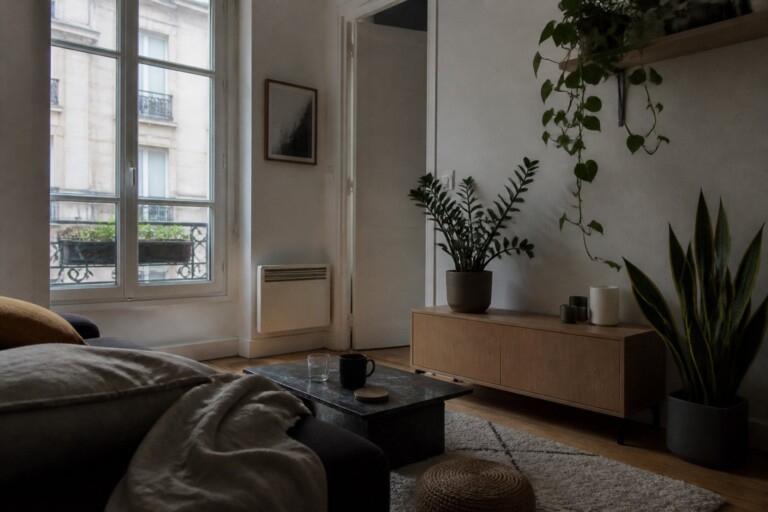
An indoor vertical garden works if you place it within 1–1.5 metres of a bright window, ideally south- or west-facing. The second critical point is water: without a reservoir or saucer under every pot, each watering risks ending up on the floor.
Indoors, plants grow more slowly but drink less. There’s no wind and the temperature is stable. That’s why many herbs cope better in the living room in winter than on the balcony.
Do you need a grow light to grow indoors?
Not always. Next to a south-facing window, basil and thyme grow well from April to September. From November to February the light drops a lot, and a 10–20 W LED lamp switched on for 10–12 hours a day makes the difference. Away from windows, choose houseplants or orchids instead of herbs.
How do you keep water off the floor?
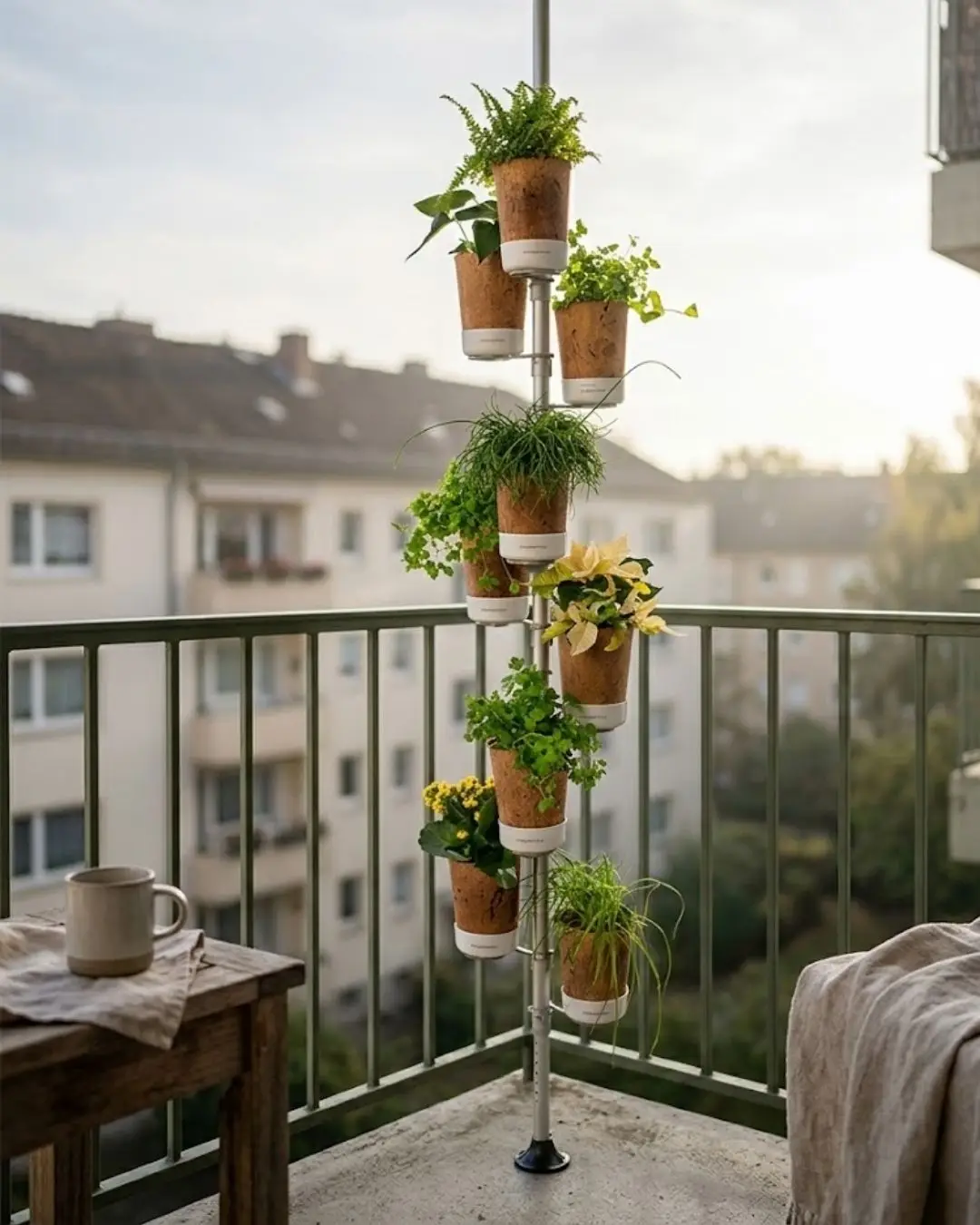
Use pots with a water reserve at the base. In the Urban Planty system each coconut-coir pot has a 300 ml reservoir that helps regulate moisture: excess water stays there and the roots take it up when needed. You no longer need a saucer. Water slowly, 150–200 ml at a time, and check after ten minutes.
Which plants grow in an indoor vertical garden?
Basil, thyme, mint, rosemary and chives near the window. Orchids, pothos and small decorative plants further into the room. Cut-and-come-again lettuce, cherry tomatoes and chillies work too, as long as they fit in a 1.5-litre pot. Avoid root vegetables and heavy bushy plants.
Vertical garden prices: DIY or a ready-made system?
A DIY vertical garden costs €20–60 in materials, but takes anything from half a day to a weekend and almost always a drill. Felt pockets cost €15–50. Ready-made systems range from about €100 to over €500, depending on materials and irrigation.
The purchase price, though, says little. What counts is how long the solution lasts and how many plants you lose in the first summer. A €30 pallet that rots after one winter costs more than it seems.
How much does a DIY vertical garden cost?
A wooden pallet with pockets costs €20–40, plus outdoor paint and a waterproof liner. A shelving unit with shelves and pots costs €40–60. Add 4–6 hours of work. Both options have to be fixed to the wall, and in a rented flat you often can’t do that.
How much does a ready-made system cost?
Wall-mounted felt pockets are cheap but dry out quickly. Modular panels with drip irrigation start at €150–200 and need a water connection. The Urban Planty kit with 9 coconut-coir pots costs €149 including shipping and installs without drilling.
How long does a vertical garden last?
The aluminium structure has no practical expiry date. Coconut-coir pots usually last 2–4 years, longer indoors, and can be replaced one at a time. Felt outdoors often wears out in 1–2 seasons. Untreated wood rots within 2–3 winters.
The right plants for each exposure
Choose plants based on the hours of sun your balcony gets, not on what you find at the garden centre. South-facing: rosemary, thyme, sage, oregano and basil. East- and west-facing: parsley, chives, lemon balm and strawberries. North-facing: mint, ferns, ivy and begonias.
A vertical system has an extra advantage: the top pots get more light than the bottom ones. Put sun-loving plants in the top three rings and partial-shade plants lower down.
Which herbs can handle full sun?
Rosemary, thyme, sage and oregano are Mediterranean plants. They cope with 8 hours of sun and a few days of drought. Basil loves the sun but drinks a lot: in July, outdoors, check it every day.
What to grow on a north-facing balcony?
With 1–2 hours of direct light, forget basil and rosemary. Mint, parsley, chives, ferns and ivy all work. Begonias flower in low light too. If you’d like more ideas for herbs, read our guide to growing herbs on the balcony.
Can you mix different plants in the same vertical garden?
Yes, as long as each plant has its own pot. In continuous felt pockets the roots share the same soil and the same water: the rosemary rots while the mint goes thirsty. With separate pots you water each one according to its needs.
No-drill assembly in 4 steps
A pressure-fit vertical garden goes up in 15–30 minutes without tools. You extend the telescopic pole to the ceiling, lock it, position the rings and insert the pre-planted pots. No screws, no holes: ideal for apartment-block balconies and rented homes.
The Urban Planty system uses an aluminium pole adjustable up to 2.85 m. An optional extension is available for higher ceilings. The lower part of the pole can also be used on its own, up to 160 cm, as a stand near a window.
- Measure the height. Measure from the floor to the ceiling of the balcony or room. On a balcony you need the slab of the floor above or a solid canopy.
- Lock the pole. Extend the telescopic pole to the ceiling and engage the pressure lock. The adjustable foot compensates for slightly sloping floors.
- Arrange the rings in a spiral. Position the 9 rings in a spiral, 20–30 cm apart in height. That way every pot gets light without shading the one below.
- Plant and insert the pots. Fill the pots with potting soil, plant, water and slot them into the rings. Taller plants go at the bottom.
Do you need a ceiling to install it?
For the full installation, yes: the pole locks between floor and ceiling. On an uncovered balcony you can use just the lower part, up to 160 cm, as a shorter stand.
Will it damage the ceiling or floor?
No, if installed correctly. The pressure is distributed vertically across the two contact points, with no screws. It’s designed for rented flats and finished interiors.
The mistakes that make a vertical garden fail
Most vertical gardens fail because of water, not plants. Felt pockets dry out in 1–2 days in summer, and pots without drainage rot the roots. The second mistake is planting everything in the same soil. The third is ignoring the hours of sun.
Why do felt pockets disappoint in summer?
Many guides recommend them because they’re cheap. Nobody tells you that felt evaporates water across its entire surface. On a south-facing balcony in July, a 2-litre pocket can dry out in a single afternoon. And the water dripping from the top pocket wets the wall and the pocket below.
How often should you water a vertical garden?
Outdoors, with sun and wind, every 1–2 days in summer. Indoors, with a 300 ml reservoir, every 3–7 days depending on the plant. Don’t follow a calendar: touch the soil with your finger. If it’s dry 2 cm down, water.
Is plastic or coconut coir better?
Dark plastic in direct sun heats the soil by several degrees and cooks the roots. Coconut coir is porous: it lets air through and cools itself by evaporation. Even the Royal Horticultural Society considers coir a valid alternative to peat.
Which species cope with a north-facing room is covered in our guide to low light houseplants.
Frequently asked questions
How much does a balcony vertical garden cost?
A DIY vertical garden costs €20–60 in materials, plus a few hours of work and a drill. Felt pockets cost €15–50. Ready-made systems cost from about €100 to over €500. The Urban Planty kit with 9 pots costs €149, shipping included.
Can you make a vertical garden without drilling the wall?
Yes. A pressure-fit system locks between floor and ceiling, with no screws or wall plugs. It’s the simplest solution for apartment blocks with strict rules and for rented homes. Alternatively there are freestanding floor structures, but they take up more space.
Which plants should go in a balcony vertical garden?
It depends on the exposure. With 6 hours of sun or more: rosemary, thyme, sage, oregano and basil. With 3–5 hours: parsley, chives, lemon balm and strawberries. With less than 3 hours: mint, ferns and ivy. Put the sun-loving plants in the highest pots.
Does a vertical garden work in winter too?
Yes, with the right plants. Rosemary, thyme and sage survive outdoors in most of Europe. Basil and chillies, on the other hand, can’t tolerate temperatures below 10 °C. In winter you can move the system indoors, near a bright window, and water less.
Want the whole system on less than 1 m²? See how a vertical garden for the balcony works without drilling.
In short
Whether a vertical garden on the balcony or indoors succeeds or fails doesn’t come down to the plants you choose. It comes down to the system: hours of sun, water that doesn’t pool, a structure you don’t have to drill into and separate pots for different plants.
If you’re looking for a system designed exactly for this, take a look at how it works in the Urban Planty vertical garden: 9 coconut-coir pots arranged in a spiral, pressure-fit mounting, patented design. It’s already in more than 10,000 European homes.
— Alex