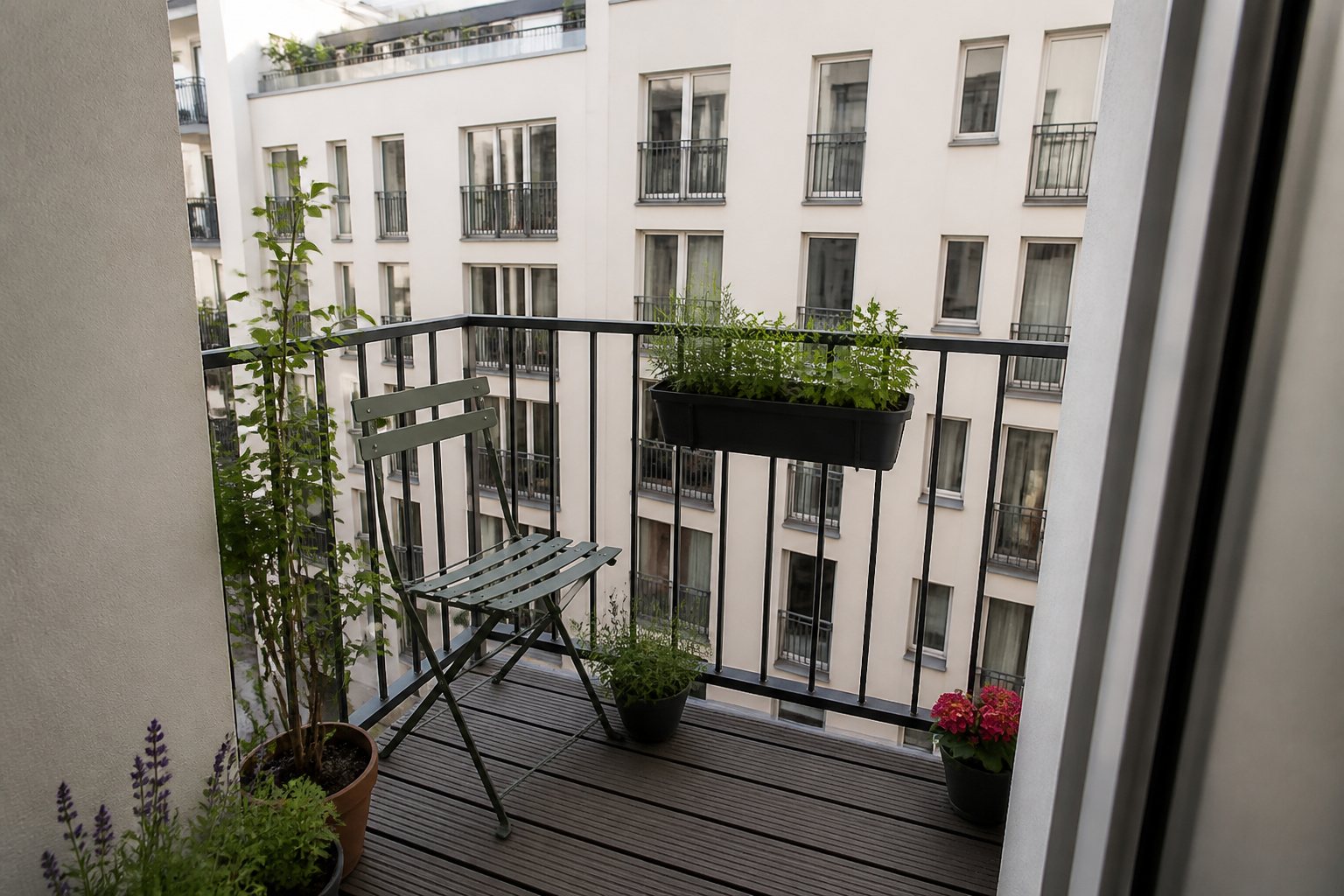

A balcony of two to four square metres can hold a table for two, a dozen pots and enough herbs for the kitchen. The trick is to stop thinking in floor space and start thinking in height, and to choose plants for the light the balcony actually gets.
Most small balconies fail for the same reasons. The floor fills up with pots in the first week, the plants do not suit the orientation, and by July nobody can reach the door without stepping over a watering can.
On a small balcony, keep the floor clear and grow upwards: planters on the inside of the railing, a freestanding vertical garden or shelf against the wall, one or two hanging pots. Choose plants by orientation: tomatoes, chillies and Mediterranean herbs for south and west, lettuce, parsley, begonias and fuchsias for east and north. Use folding furniture, saucers under every pot and keep heavy containers next to the wall.
Where do you start with a small balcony?
Measure first. Note the floor area, the length of the railing and the height to the ceiling or the balcony above. A typical 1.2 by 2.5 metre balcony has 3 m² of floor but almost 4 metres of railing and 2.5 metres of height, which is where most of the growing space is.
Then watch the light for a full day. Count the hours of direct sun in early summer: more than six is a sunny balcony, three to four is partial shade, under two is shade. This decides what will grow far more than the pots you buy.
Finally, read the house rules or tenancy agreement. Many buildings restrict planters on the outside of the railing, drilling into the facade or anything that drips onto the balcony below.
How can you use vertical space on a small balcony?
There are four main options, and most small balconies use two or three of them together.
- Railing: troughs on brackets along the railing. The cheapest way to add a metre or more of planting without using any floor.
- Wall: a trellis, a narrow shelf or wall-mounted pockets. Fixing them usually means drilling, which in a rented flat needs the landlord’s consent.
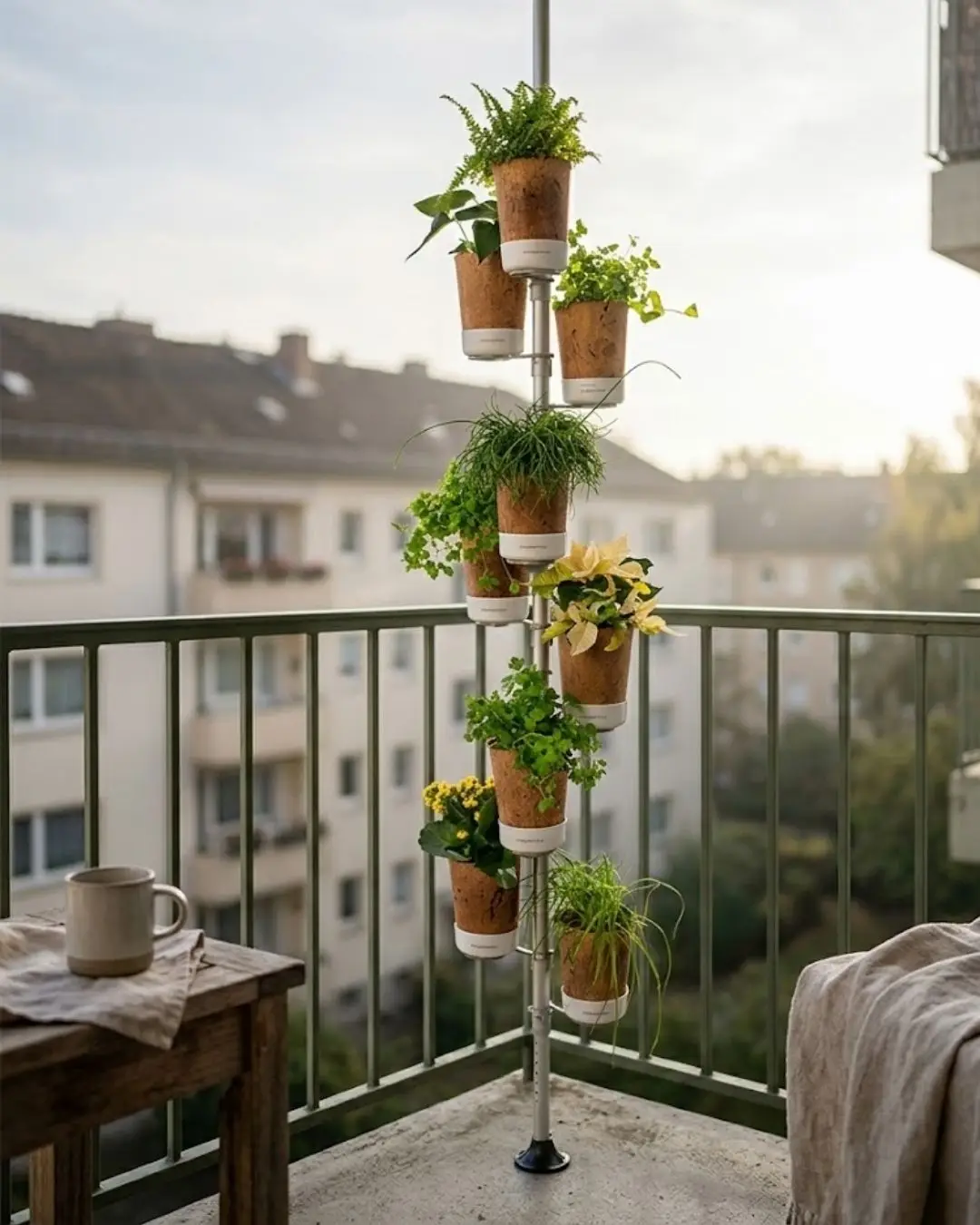
- Pole systems: a telescopic pole clamped between floor and ceiling holds pots at several heights without a single hole. It suits rented flats and corners where nothing else fits.
- Hanging: one or two hanging pots from a ceiling hook or a railing bracket, for trailing plants that would otherwise take shelf space.
Which railing planters and hanging pots work best?
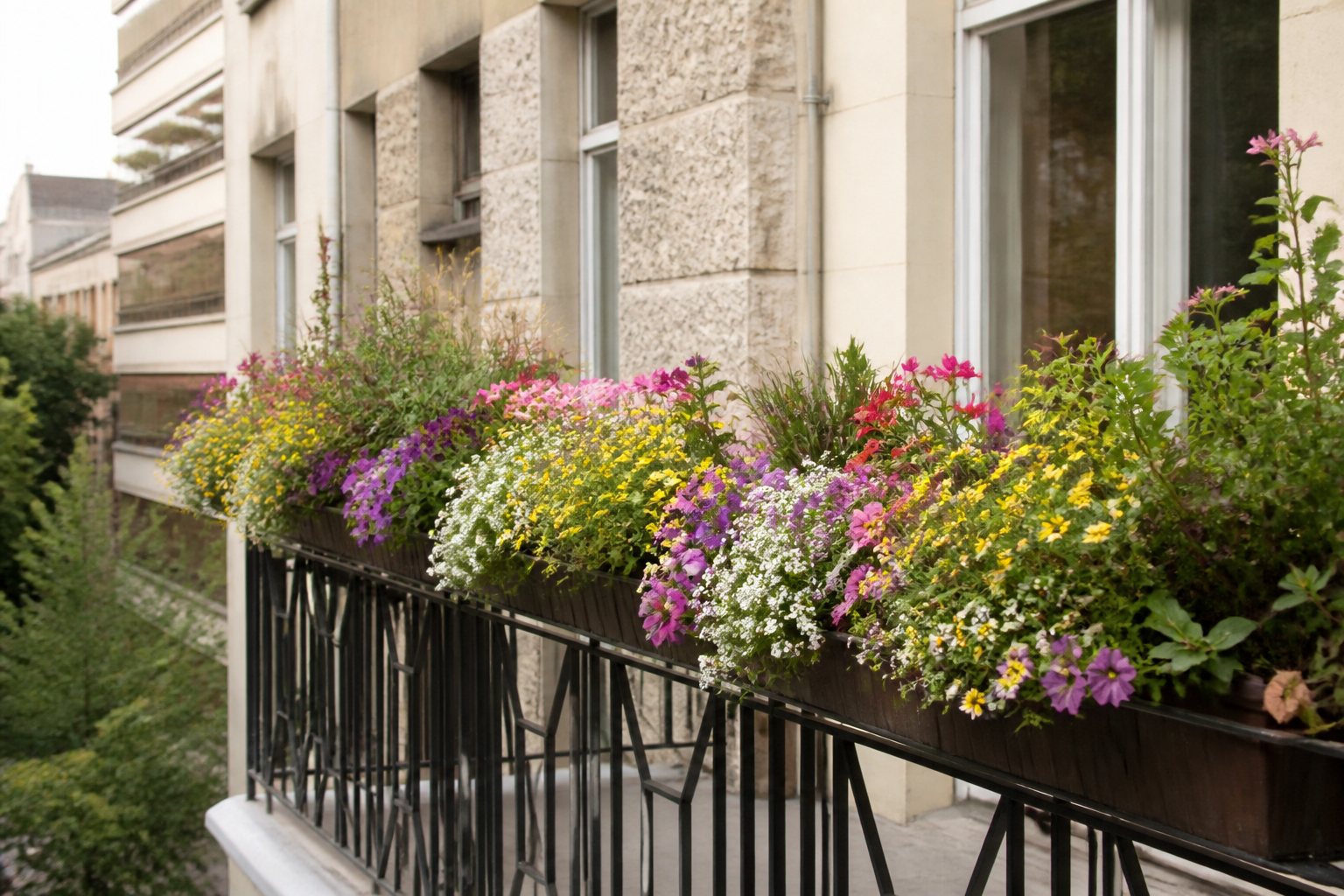
Choose troughs at least 15 to 20 cm deep with drainage holes. Shallow ones dry out by midday in July. Brackets must match the profile of your railing and be screwed tight so the wind cannot lift them; an 80 cm trough full of wet compost weighs 15 to 25 kg.
Hang troughs on the inside of the railing where you can.
Hanging pots look light but dry out fastest of all, and in summer they often need water every day. Use a hook rated for the weight: a 30 cm hanging basket with wet compost weighs 5 to 10 kg.
Which plants suit a sunny, east-facing or north-facing balcony?
Orientation matters more than skill. A south-facing balcony in central Europe can reach well over 35 °C on a July afternoon, while a north-facing one stays cool but gets almost no direct sun.
| Orientation | Direct sun | Flowers | Herbs and edibles |
|---|---|---|---|
| South | more than 6 hours, hot | pelargoniums, petunias, verbena, portulaca | cherry tomatoes, chillies, basil, thyme, rosemary, oregano |
| West | afternoon, 4 to 6 hours | pelargoniums, calibrachoa, petunias | cherry tomatoes, chillies, sage, oregano |
| East | morning, 3 to 4 hours | begonias, fuchsias, lobelia, New Guinea impatiens | lettuce, rocket, parsley, chives, mint, strawberries |
| North | under 2 hours | begonias, fuchsias, busy lizzies, ivy | mint, parsley, chives; little or no fruit |
Which herbs and vegetables grow well on a small balcony?
Concentrate on plants that give a lot from a small pot and that you would otherwise buy often. Tender crops go out after the last frost, in most of central Europe from mid-May; lettuce, radishes and parsley can be sown from April.
- Cherry tomatoes: one plant per pot of at least 10 to 15 litres, a cane for support and six hours of sun.
- Chillies and sweet peppers: 5 to 10 litres per plant; they like the warmest spot by the wall.
- Lettuce and rocket: a 15 cm deep trough is enough. Sow a short row every three weeks.
- Herbs: thyme, rosemary, oregano and sage want sun and free-draining compost; basil wants warmth and more water. Plant mint in its own pot, because it spreads.
- Strawberries: do well in hanging pots and vertical systems.
Herbs fail on balconies for a handful of predictable reasons, mostly wrong light and wet roots. They are covered in our balcony herb garden guide.
What furniture fits a balcony of 2 to 4 m²?
Folding furniture is the single biggest space saver. A bistro set with a round table of about 60 cm and two folding chairs fits on 1.5 m² and can lean against the wall when you need the room.
Even smaller is a table that hooks onto the railing and folds down flat. Keep a clear path of about 60 cm from the door so the balcony stays usable.
How much weight can a balcony take, and what about drainage?
Wet compost weighs roughly 1 kg per litre, so a 40-litre tub with a small shrub can weigh 50 kg. Balconies are designed to carry people and normal furniture, but the load-bearing capacity varies with age and construction and is not something to guess. If you plan large tubs or a raised bed, ask the landlord or building manager.
Place the heaviest containers close to the house wall rather than at the outer edge, spread them out instead of grouping them in one spot, and use lightweight plastic or fibre pots instead of terracotta for anything large.
What does a sample plan for a 3 m² balcony look like?
This layout is for a balcony of about 1.2 by 2.5 metres with partial or full sun. Adjust the plant choice to your orientation using the table above.
- Railing: two 80 cm troughs on the inside of the railing, one with herbs near the door, one with flowers or lettuce.
- Corner by the wall: a vertical garden or narrow shelf with nine plants: strawberries, lettuce, parsley, chives and a few flowers.
- Sunniest spot on the floor: one 15-litre pot with a cherry tomato on a cane and one 10-litre pot with a chilli.
- Hanging: one hanging pot with trailing strawberries or calibrachoa, if there is a safe fixing point.
- Seating: a folding table and two folding chairs, or a railing table, with a 60 cm clear path to the door.
That is around 20 plants on 3 m², and the floor still has room for two people to sit. For more ideas on growing upwards, see our guide to vertical gardens on the balcony and indoors.
Where does a freestanding vertical garden fit in?
When the railing is full and drilling is not an option, a vertical garden without drilling uses the height between floor and ceiling. The Urban Planty vertical garden is a telescopic pole that clamps between floor and ceiling and adjusts up to 285 cm, so it suits rented flats.
It holds nine pots, each with a 300 ml water reservoir, so it usually needs watering once or twice a week. It takes less than 1 m² of floor, works on a balcony or indoors next to a window, and costs €149 with free shipping.

Frequently asked questions
How do you make a small balcony garden look bigger?
A small balcony garden looks bigger when the floor stays clear: put plants on the railing, on a vertical system or shelf against the wall and in hanging pots, use folding furniture and stick to two or three pot colours.
What can I grow on a north-facing balcony?
A north-facing balcony suits begonias, fuchsias, busy lizzies and ivy, plus mint, parsley and chives. Fruiting crops such as tomatoes and chillies need at least six hours of sun and will not crop well there.
Can I hang planters on the outside of a balcony railing?
Planters on the outside of a balcony railing are restricted in many buildings, so check the house rules or tenancy agreement. Hanging them on the inside is safer and keeps water from dripping onto the balcony below.
How heavy are balcony pots when wet?
Wet compost weighs roughly 1 kg per litre, so a 40-litre balcony tub can weigh around 50 kg with the plant. Keep heavy pots close to the house wall and ask the building manager before adding large containers.
Which vegetables are easiest on a small balcony?
The easiest vegetables for a small balcony are cherry tomatoes and chillies on a sunny balcony, and lettuce, rocket and radishes in partial shade. Herbs such as parsley, chives and thyme are the most useful per pot.