
A houseplant lives in a few litres of compost at most, and the nutrients in it run out within months. Feeding replaces them, but more plants are harmed by too much fertiliser than by too little. Here is what the numbers on the bottle mean, when to feed and how much is enough.
Fresh potting compost usually contains enough nutrients for the first six to eight weeks. After that, every watering washes a little out through the drainage holes and the roots take up the rest. By the second summer in the same pot, most plants are running on empty.
Fertilize houseplants from March to September, when they grow, and stop or nearly stop in winter. Use a liquid feed at half the strength on the label every two to four weeks, always on moist compost. Cacti and orchids need less, citrus more. Flush the pot with plain water a few times a year to remove salts.
What do the NPK numbers on fertiliser mean?
Every fertiliser label shows three numbers, for example 7-3-6. They are the percentages of nitrogen (N), phosphorus (P, given as phosphate) and potassium (K, given as potash). A feed marked 7-3-6 therefore contains 7 per cent nitrogen, 3 per cent phosphate and 6 per cent potash by weight.
Nitrogen drives leaf and shoot growth, which is why feeds for green foliage plants are higher in N. Phosphorus supports roots and flowering. Potassium helps the plant regulate water and is important for flowers and fruit, so tomato and flowering-plant feeds are higher in K.
Good feeds also contain trace elements such as iron and magnesium. For most homes, one balanced general feed suits nearly every plant.
When should you fertilize houseplants?
Feed when the plant is growing. In central Europe that means roughly March to September, when days are long enough for new leaves. Start when you see fresh growth in spring and taper off in October.
From November to February most houseplants grow very little. Nutrients they cannot use stay in the compost as salts. Stop feeding over winter, or give at most a quarter-strength dose once a month to plants that clearly keep growing, for example under a grow light.
Do not feed a freshly repotted plant for about six weeks, a plant with bone-dry compost, or one that is sick or has just lost its roots to rot. A struggling plant needs better conditions, not more fertiliser.
How often and how much should you feed?
For most foliage and flowering houseplants, feed every two to four weeks in the growing season. Use half the dose on the label. Manufacturers state the maximum the plant can take, and indoor plants in modest light rarely need it.
In practice that means, for example, 5 ml instead of 10 ml per litre of water. Measure with the cap rather than pouring by eye. Water first if the compost is dry, then apply the feed, so it does not hit dry roots.
| Plant group | Feed | March to September | Winter |
|---|---|---|---|
| Foliage plants (monstera, pothos, rubber plant) | general liquid feed, half strength | every 2 to 3 weeks | none |
| Flowering plants (peace lily, anthurium, African violet) | flowering-plant feed, half strength | every 2 weeks | none, unless in flower |
| Moth orchid (Phalaenopsis) | orchid feed, quarter to half strength | every 2 to 3 weeks | once a month or none |
| Cacti and succulents | cactus feed, half strength | every 4 to 6 weeks, May to August | none |
| Citrus in pots | citrus feed, label dose | every 1 to 2 weeks | none if kept cool |
| Herbs on the windowsill | general or organic liquid feed, half strength | every 2 weeks | monthly if still growing |
Liquid feed, sticks or granules: which is better?
Liquid feed is the easiest to control. It reaches the roots at once and you can stop the moment you see a problem.
Fertiliser sticks are pushed into the compost and release nutrients slowly, typically over two to three months, depending on the product. They are convenient, but the concentration around each stick is high and the rest of the pot gets little, so roots next to the stick can scorch.
Slow-release granules with a coating are mixed into the compost when potting, or scattered on top. They release nutrients for three to six months, faster in warm compost. Do not add them in autumn.
Do citrus, orchids and cacti need special fertiliser?
Citrus trees in pots are hungry plants. They need more nitrogen and regular iron and magnesium, otherwise young leaves turn yellow between green veins. A dedicated citrus feed at the label dose through spring and summer is worth it. In winter, kept at 5 to 12 °C, they do not need feeding.
Moth orchids grow in bark, which holds almost no nutrients, but their roots are sensitive to salts. The rule is weak and regular: a quarter to half strength every two to three weeks while new leaves or roots appear.
Cacti and succulents grow slowly and need little. A low-nitrogen cactus feed three or four times between May and August is plenty. Too much nitrogen makes them soft, pale and stretched.
What are the signs of too much or too little fertiliser?
Overfeeding
- brown, crispy leaf tips and edges, starting on older leaves
- a white crust on the compost surface or the pot rim
- wilting even though the compost is moist, because salts damage the roots
- soft, long-jointed growth that attracts aphids
Underfeeding
- older, lower leaves turn evenly pale or yellow while new growth stays green
- new leaves are noticeably smaller than the old ones
- growth stalls in summer although light and watering are right
- flowering plants bud poorly or not at all
Yellow leaves are not always a nutrient problem. Most often the cause is watering, so check that first. Our guide on how to water houseplants explains how to read the compost before reaching for the bottle.
Why does a white crust form, and how do you flush the pot?
The white or yellowish crust on the compost and on terracotta is a mix of lime from tap water and fertiliser salts. In much of central Europe tap water is moderately hard to hard, so the crust builds up within one or two seasons.
- Scrape off the top 1 to 2 cm of compost if it is crusted and replace it with fresh compost.
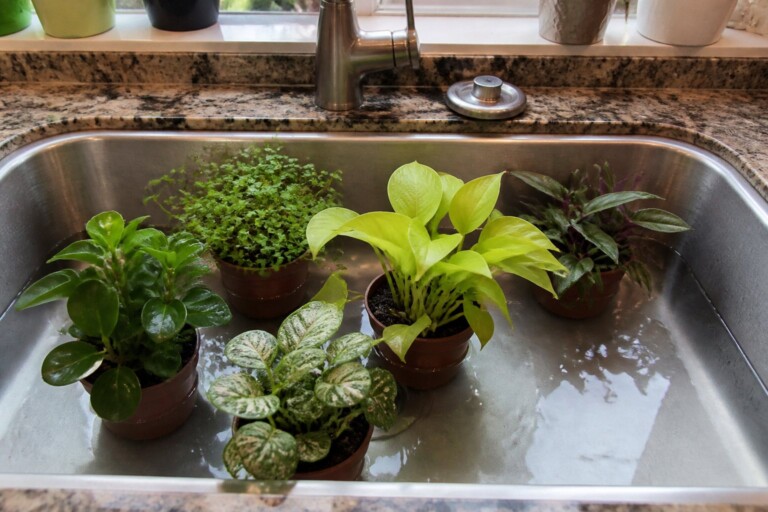
- In the bath or shower, slowly pour room-temperature water through the pot, about twice the pot volume, and let it drain completely.
- Repeat every two to three months in the growing season, and skip feeding for the next two weeks.
- Clean the outside of empty terracotta pots with a solution of one part vinegar to four parts water.
Do coffee grounds, eggshells and banana peel work as fertiliser?
Only to a very small degree, and in a pot they cause more trouble than they solve. Used coffee grounds contain some nitrogen, but they break down slowly, form a water-repellent layer on the surface, go mouldy and attract fungus gnats. They do not noticeably acidify the compost either.
Eggshells are mostly calcium carbonate. In a pot they decompose so slowly that they add practically nothing in a season, and hard tap water already supplies plenty of calcium. Banana peel contains potassium, but on the surface of a pot it rots, smells and draws fruit flies.
Organic feeding indoors is possible, though. Liquid organic feeds based on plant extracts work like mineral ones, only a little slower. Worm compost can be mixed into the top layer in spring, a tablespoon or two per pot of 15 cm diameter. Kitchen scraps belong on the compost heap, not in the flowerpot.
Feeding plants in small pots and vertical gardens
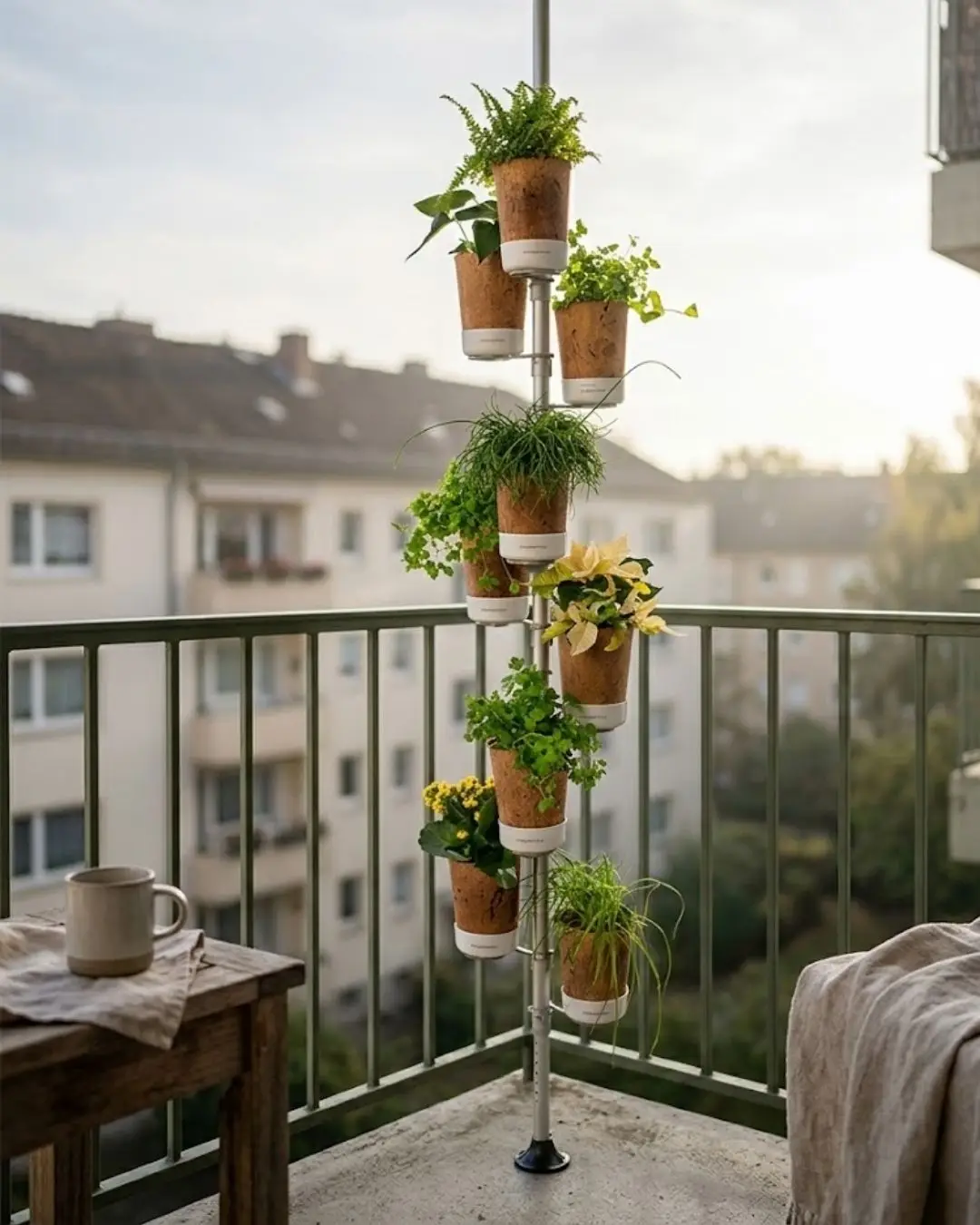
The smaller the pot, the faster the nutrients run out. Herbs and leafy plants in pots of a few hundred millilitres benefit from a half-strength liquid feed every two weeks in summer. This also applies to a vertical garden without drilling such as the Urban Planty vertical garden, where nine plants grow in pots with a 300 ml water reservoir each: add the diluted feed to the water every second time you top up. Our list of easy houseplants for beginners suggests what to grow.
Frequently asked questions
When should you stop fertilizing houseplants?
Stop fertilizing houseplants in October and resume in March, when new growth appears. In winter most houseplants barely grow, so unused fertiliser builds up as salts in the compost.
How much should you dilute houseplant fertiliser?
For most houseplants, use half the dose on the label, for example 5 ml instead of 10 ml per litre of water. Orchids get a quarter to half strength, while citrus trees in summer can take the full label dose.
Are fertiliser sticks good for houseplants?
Fertiliser sticks work for houseplants if you want to feed less often, but they release nutrients unevenly. Roots next to the stick can scorch while the rest of the pot gets little, so liquid feed is easier to control.
Are coffee grounds good for houseplants?
Coffee grounds are a poor fertiliser for houseplants. They contain little available nitrogen, form a crust on the compost, go mouldy and attract fungus gnats, so they are better added to the compost heap.
Should you fertilize a newly repotted plant?
A newly repotted plant does not need fertiliser for about six weeks, because fresh potting compost already contains nutrients.