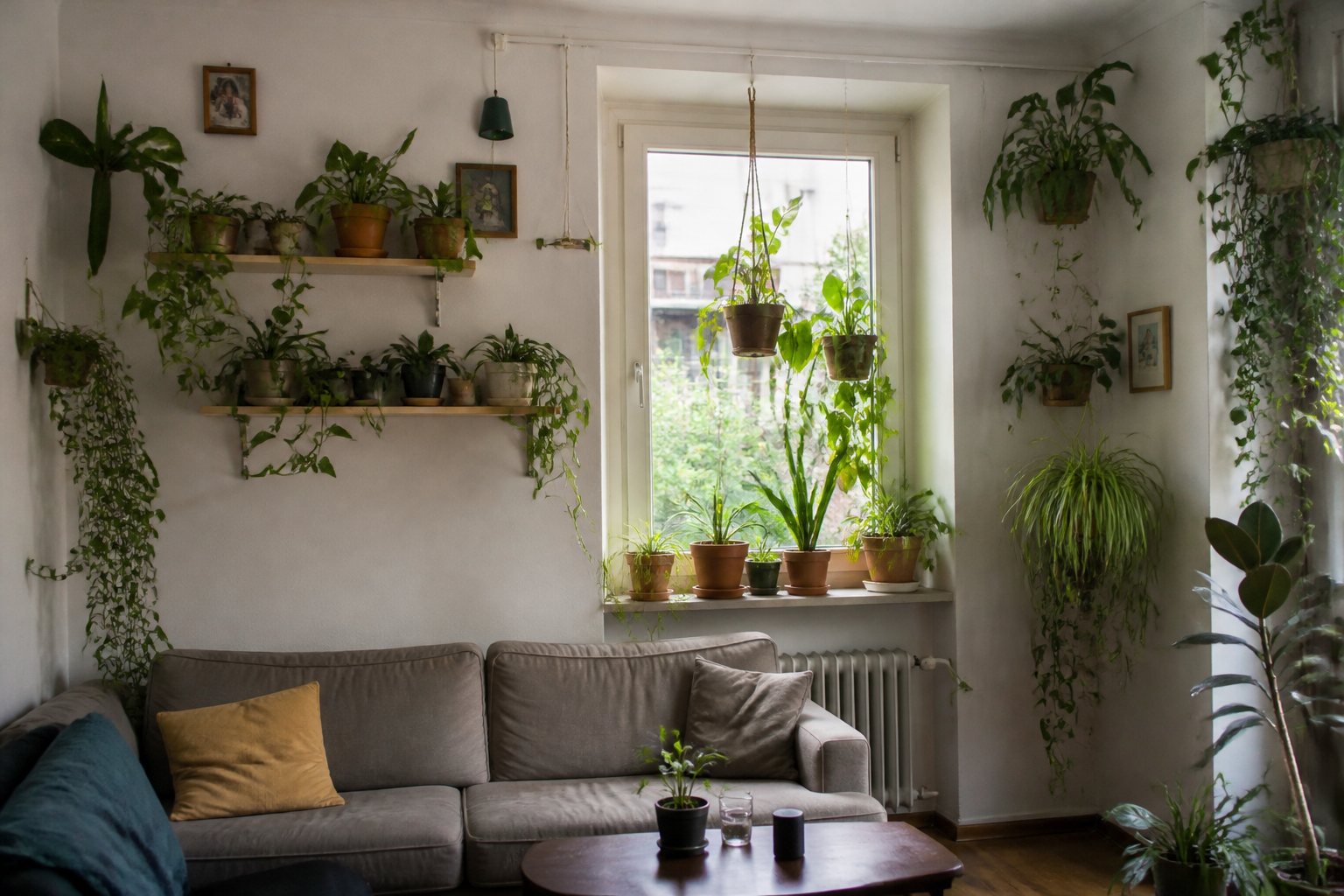

An indoor living wall can cost as much as a new kitchen or as little as a few shelves and pots. The real difference lies in how much water, light and drilling each version needs. We compared six approaches and looked at them through the eyes of a tenant as well as an owner.
Plants on a wall tend to fail for the same reasons. They sit too far from the window, watering is awkward, and water ends up on the floorboards. Most of these problems can be foreseen before the first pot is bought.
Below are rough costs, the care each option needs, the plants that genuinely cope indoors, and a few rules for protecting walls and floors.
There are six main ways to build an indoor living wall: a professional irrigated system (from roughly €500 per m²), wall pockets, shelves or a ladder, hanging planters, preserved moss panels and a floor-to-ceiling vertical garden. Renters do best with a leaning ladder, freestanding shelves or a tension-pole garden, as none needs drilling. Keep plants within 1 to 2 metres of a window.
What are the options for a living wall indoors?
The term green wall covers six quite different things. Some are true gardens on a wall with built-in irrigation, others are simply pots arranged with some thought. The table sets out typical costs and the work involved.
| Option | Typical cost | Maintenance | Drilling | Renter-friendly |
|---|---|---|---|---|
| Professional living wall with irrigation | from about €500 per m², installed | regular servicing, pump, feed | yes, often plus water and power supply | no |
| Wall pockets and modules | €20–80 per module | frequent watering, felt dries out fast | yes | partly, holes need filling |
| Shelves or ladder | €40–200 | as for ordinary pots | shelves yes, leaning ladder no | ladder yes |
| Hanging planters | €10–40 each | watering at height, drips | ceiling hook | partly |
| Preserved moss panels | about €200–500 per m² | almost none, no watering | screws or adhesive | partly |
| Floor-to-ceiling vertical garden | €149 | watering once or twice a week | no | yes |
Prices are indicative and vary widely between suppliers. Professional installations usually include design.
Professional living wall with irrigation
Plants grow in modules or felt fixed to a frame, while water and nutrients are piped from a tank with a pump. It is the most striking result, because the wall reads as one continuous sheet of green.
It is also the most demanding. It needs a load-bearing wall, a waterproof backing, a power point for the pump and usually a service contract. For a rented flat it is, in practice, out of the question.
Wall pockets and modules
Felt pockets or plastic modules screwed to the wall are the affordable version. The difficulty is water. Felt dries quickly in a centrally heated flat, and when you water, moisture can seep through to the plaster.
Choose modules with a closed base or an inner pot.
Shelves or a ladder
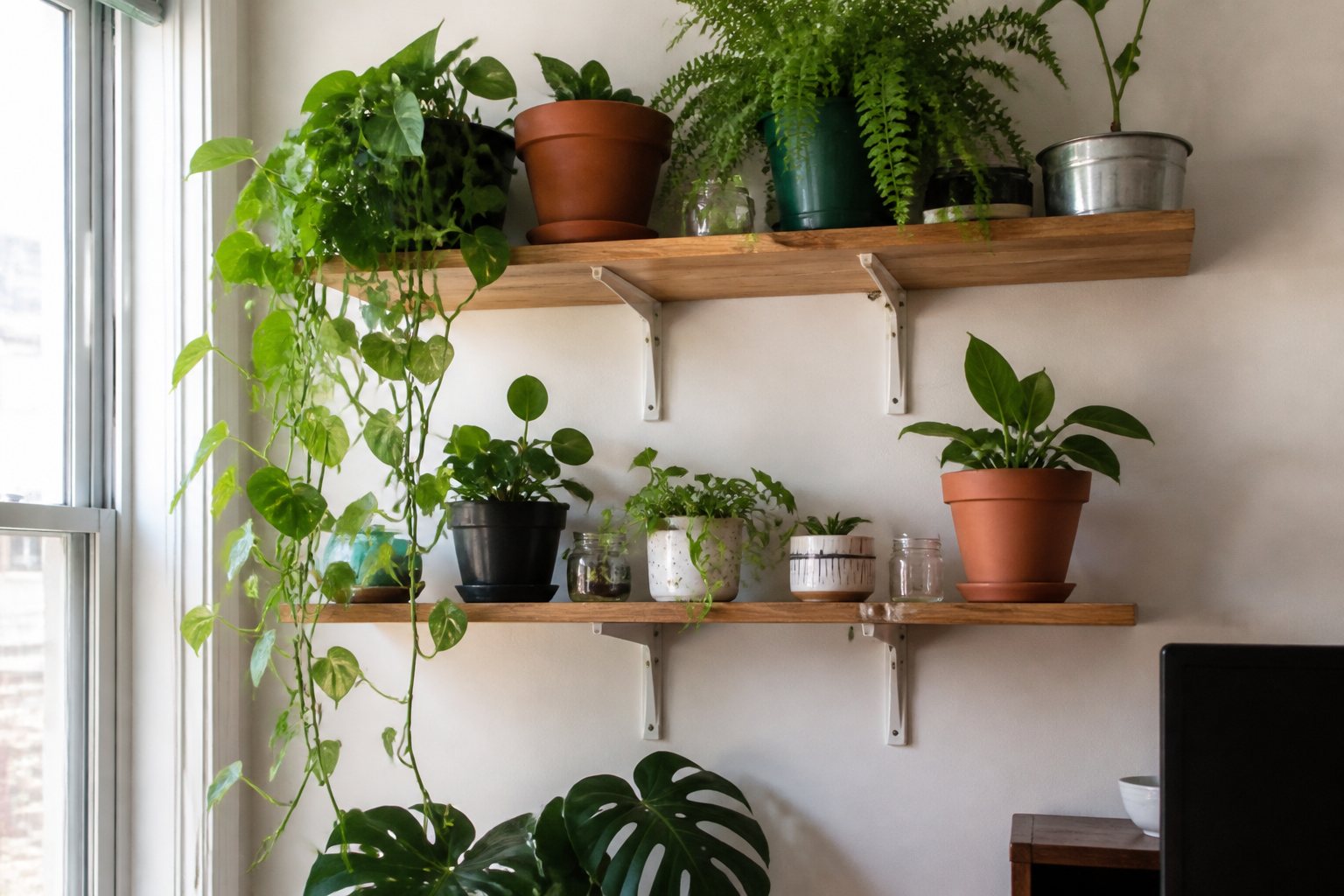
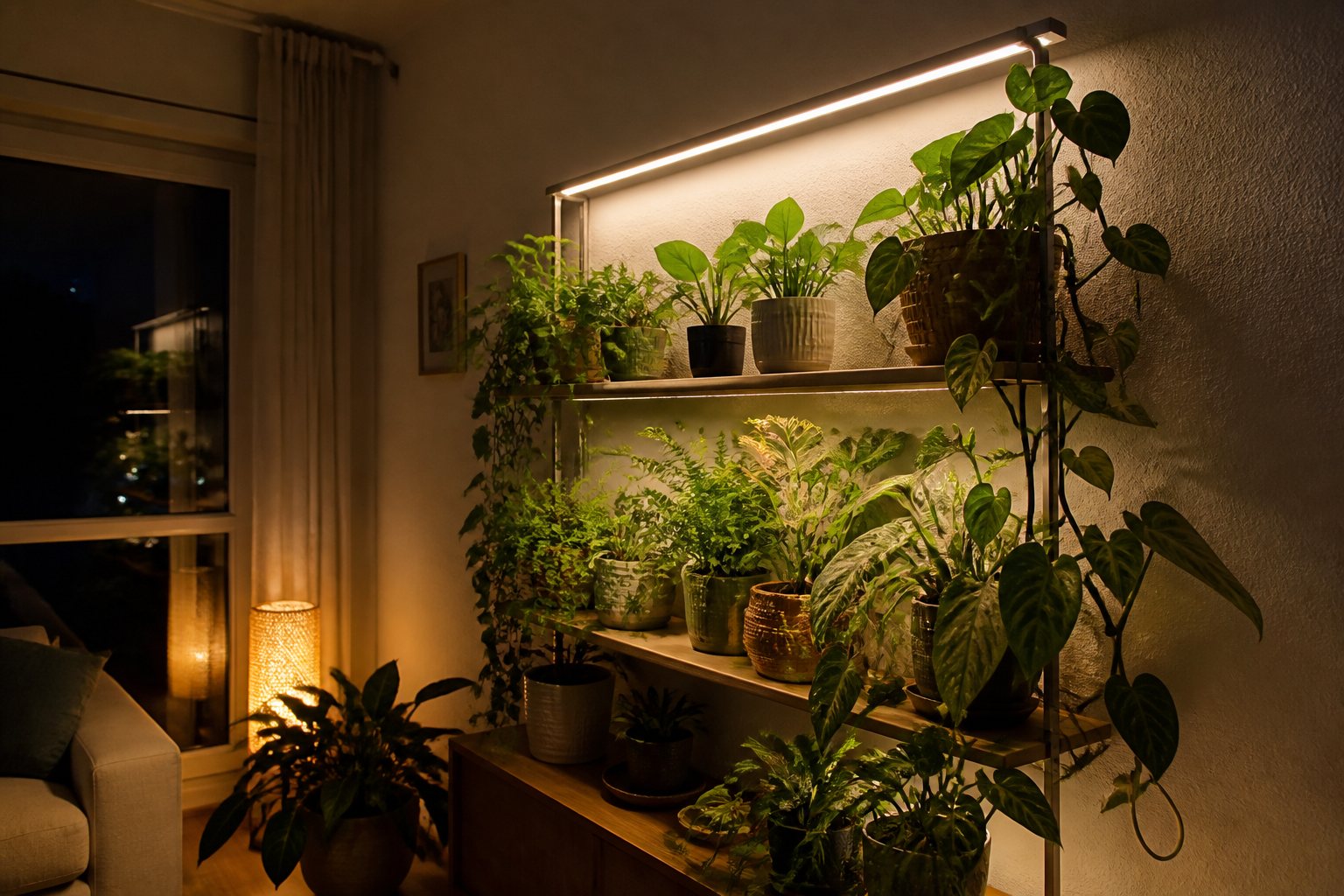
The simplest solution is often the most durable. Ordinary pots with saucers go on shelves or a leaning ladder, and plants can be moved closer to the window when needed. Let trailing pothos and philodendron spill over the edge.
Hanging planters
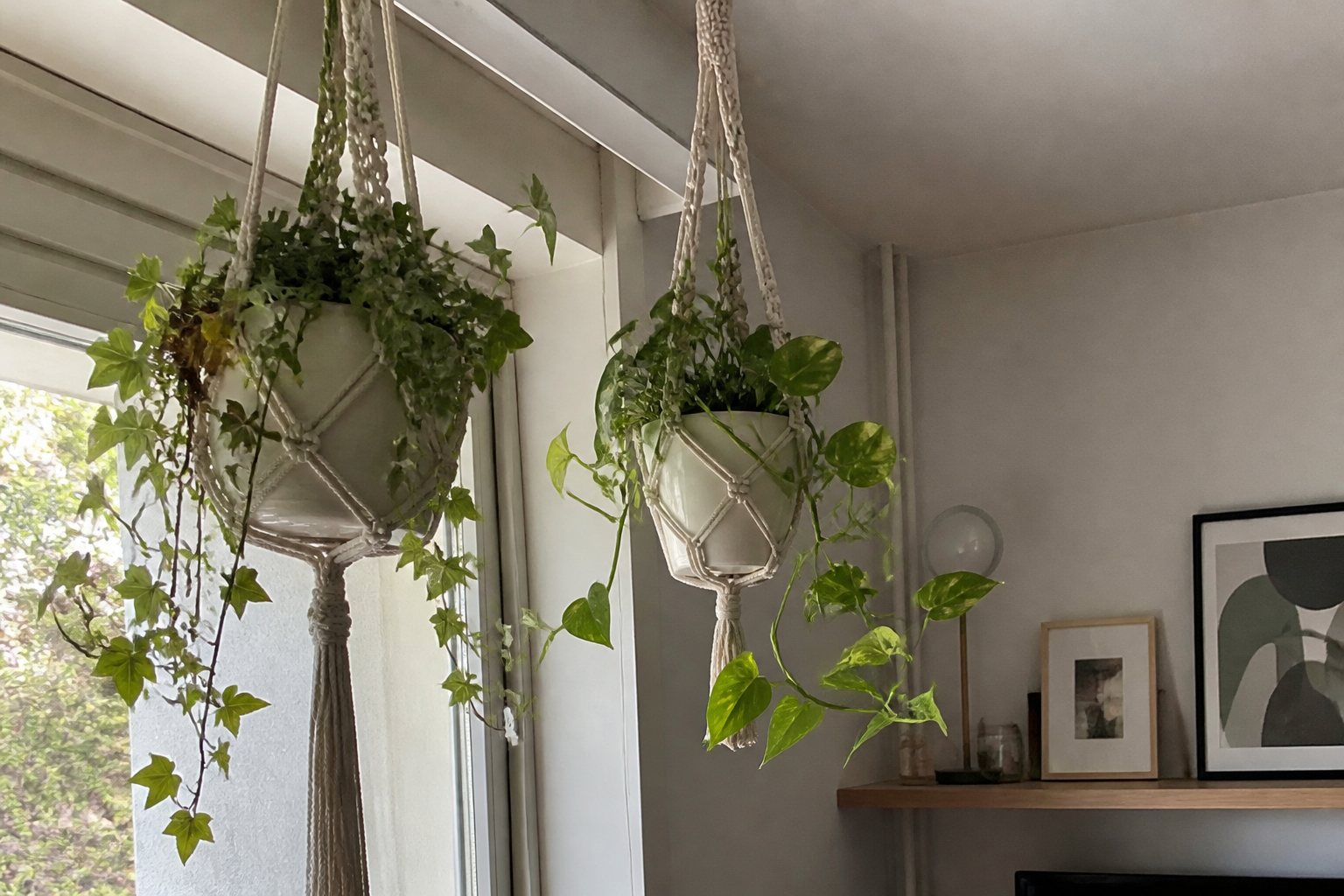
Planters in macramé hangers fill the space in front of a window, where light is strongest. A ceiling hook usually means drilling, and a pot of wet compost is heavier than it looks. Watering at head height is fiddly, so choose pots with a built-in saucer that catches excess water.
Preserved moss panels
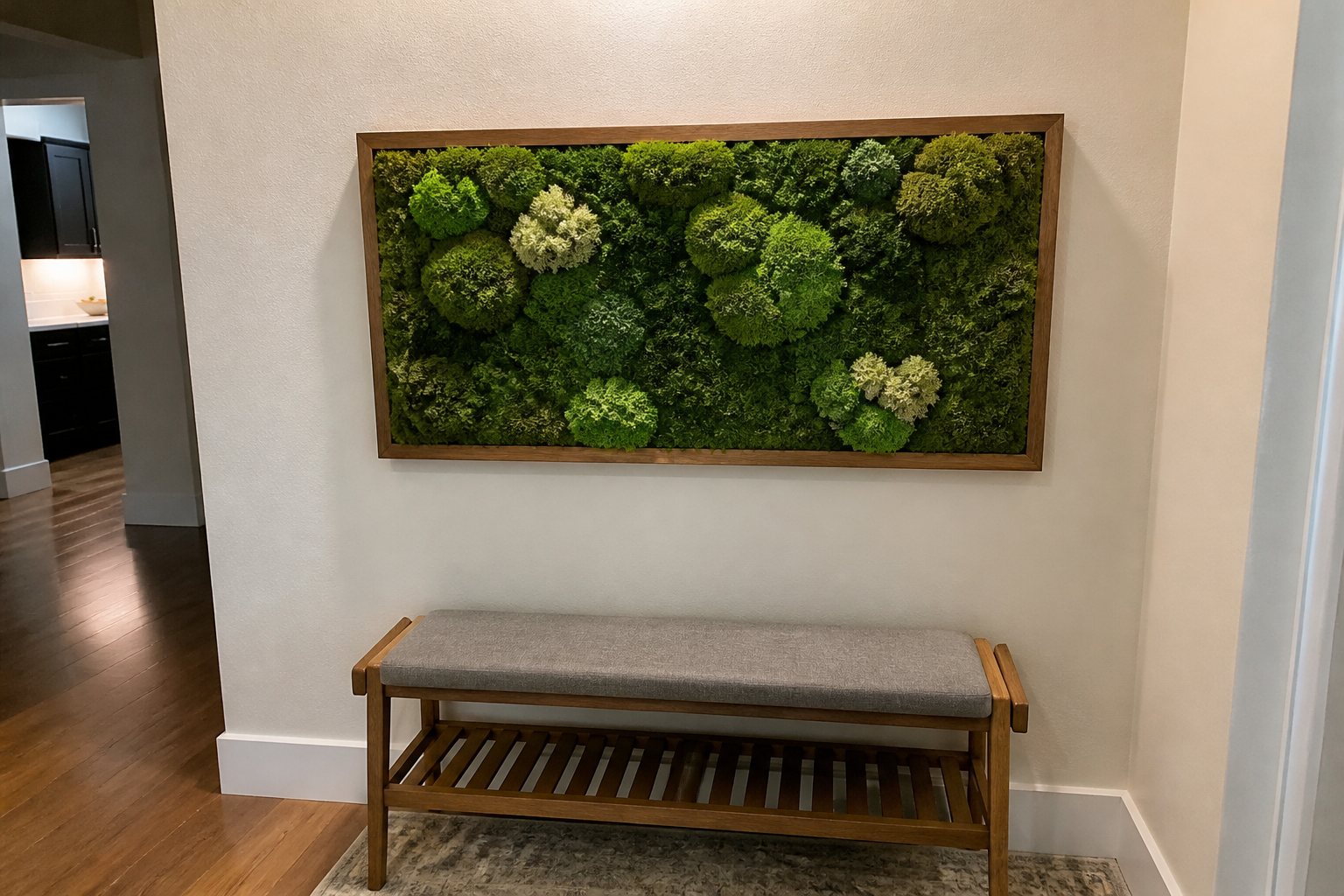
Preserved moss is not a living plant in the usual sense. It has been treated to keep its colour and softness but no longer grows. It needs neither water nor light, which makes it suitable for hallways and windowless rooms.
It dislikes direct sun, which bleaches it, and very dry air, which makes it brittle. Do not water or mist it.
Floor-to-ceiling vertical garden without drilling
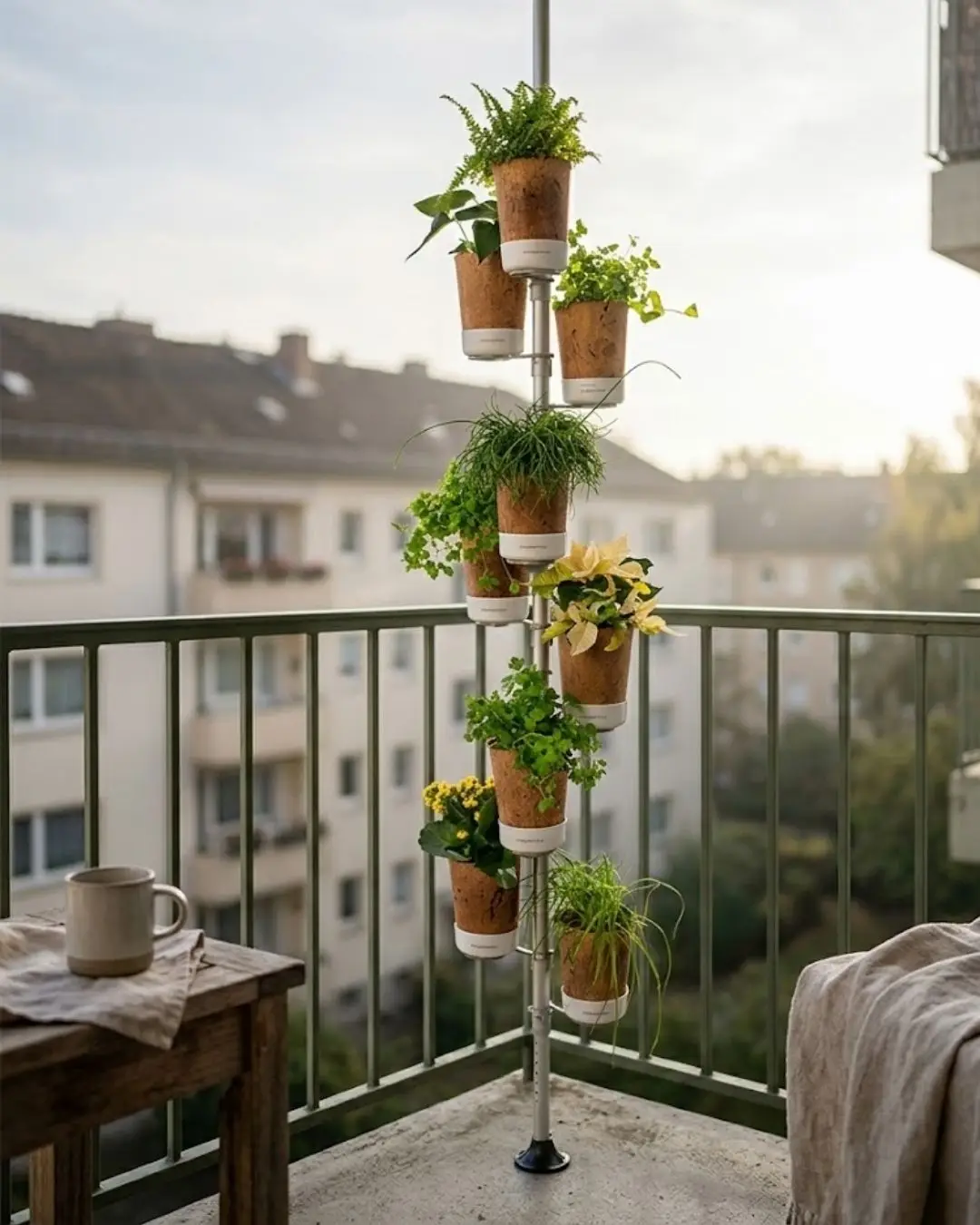
A telescopic pole is clamped between floor and ceiling and holds nine pots. This kind of vertical garden without drilling does not cover a whole wall; it creates a green column beside a window on less than a square metre of floor. The pole adjusts up to 285 cm, so it fits most flats.
Each pot has a 300 ml water reservoir, so watering once or twice a week is enough. The Urban Planty vertical garden costs €149 with free shipping. The limitation is plain: nine plants are not a whole wall. Anyone wanting green from corner to corner will need several columns or another option.
How it works on a balcony as well is covered in our guide to vertical gardens on the balcony and indoors.

How much light does a living wall need?
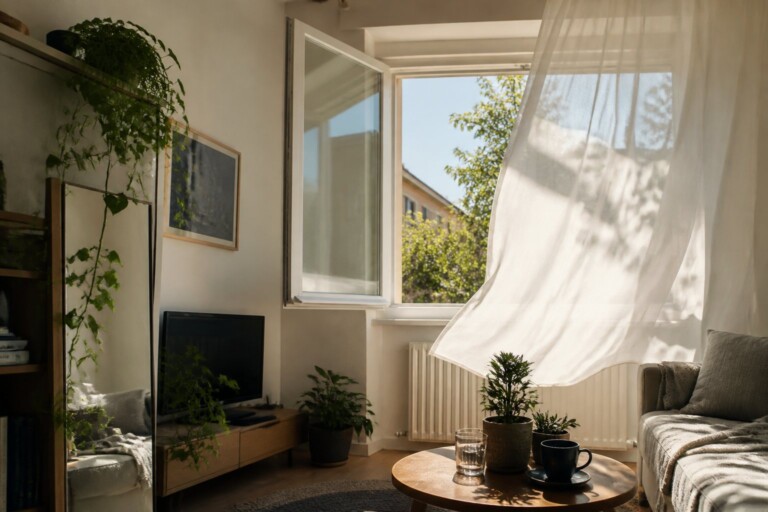
Light is the most common reason a green wall fails. The wall opposite the window looks ideal to us but is often too dark for plants. Two or three metres from the glass, only a fraction of the window light remains.
- Within 1 m of the window: herbs and plants that need plenty of light.
- 1 to 2 m from the window: pothos, philodendron, peace lily and ferns.
- More than 2 to 3 m away or in a hallway: without extra lighting, only preserved moss.
South and west-facing windows give the most light, north-facing the least. If the plants cannot move closer to the window, a full-spectrum LED grow light helps. Fit it 20 to 40 cm above the plants and run it on a timer for 10 to 12 hours a day, especially from November to February.
For darker corners we have also picked out low light houseplants that cope with a north-facing room.
Which plants are best for an indoor living wall?
Choose plants that tolerate room temperatures of 18 to 24 °C, the dry air of a heated flat and somewhat less light. These do best in practice.
- Pothos or devil’s ivy (Epipremnum aureum): grows fast, trails for several metres and tolerates partial shade. Water when the top layer of compost is dry.
- Heartleaf philodendron (Philodendron hederaceum): similar to pothos, with heart-shaped leaves. Thrives on shelves and in hanging planters.
- Ferns such as the Boston fern (Nephrolepis): fill space beautifully but need evenly moist compost and more humid air. Next to a radiator they quickly turn brown.
- Peace lily (Spathiphyllum): tolerates partial shade and droops visibly when it needs water.
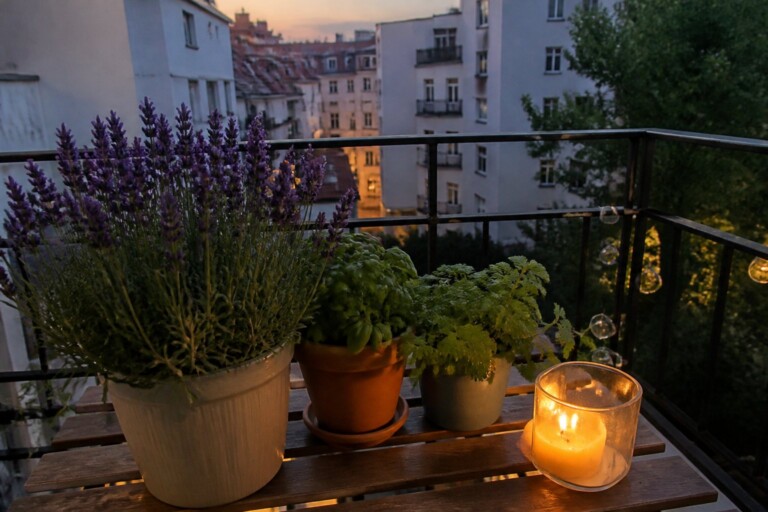
- Herbs: basil, parsley and chives only right beside a sunny south or west window or under a grow light. They will not thrive in the middle of a room.
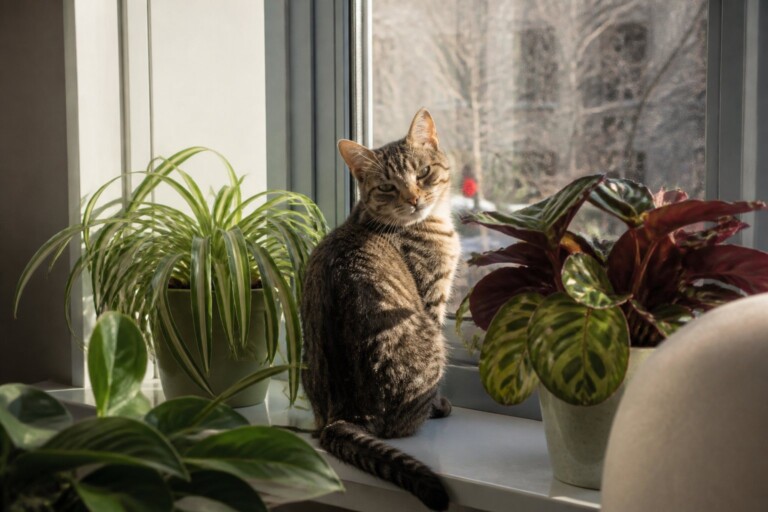
Pothos, philodendron and peace lily are toxic to cats and dogs if chewed, so keep them out of reach.
How do you protect walls and floors from water?
Water is the biggest risk with any indoor green wall. Damp behind a pot or in felt can show up as a stain on the plaster or as mould, which becomes a problem when a tenancy ends.
- Give every pot a saucer or closed reservoir that holds excess water.
- Leave a 2 to 3 cm gap between pots and wall so air can circulate.
- Use a waterproof backing for wall modules, such as a PVC board.
- Lay a waterproof mat under the lowest pots on wooden or laminate floors.
- Water slowly and empty any water left in saucers after half an hour.
How heavy is a living wall, and what can a wall hold?
A pot with two litres of damp compost and a plant weighs roughly 2 to 3 kg. Ten such pots on a shelf therefore mean 20 to 30 kg, too much for standard plugs in a plasterboard wall. On stud walls use cavity fixings or screw brackets into the studs.
Professional living walls can weigh several tens of kilograms per square metre when the growing medium is saturated, so they are planned only for load-bearing walls. Preserved moss is very light, just a few kilograms per square metre. With a floor-to-ceiling vertical garden, the floor carries the weight and the wall bears none.
Frequently asked questions
Can I create an indoor living wall without drilling?
Yes, an indoor living wall can be built without drilling. A leaning ladder, freestanding shelves and a vertical garden on a telescopic pole clamped between floor and ceiling need no holes in the wall, so they also suit rented flats.
How much does an indoor living wall cost?
A professional living wall with irrigation costs from about €500 per square metre installed, and preserved moss around €200 to €500 per m². Shelves and hanging planters cost from a few tens of euros to about €200, and a floor-to-ceiling vertical garden €149.
Which plants are best for an indoor living wall?
Pothos, heartleaf philodendron, peace lily and ferns tolerate room temperature and partial shade 1 to 2 metres from a window. Herbs such as basil need a sunny window or a grow light.
Does preserved moss need watering?
No. Preserved moss does not grow, so it is never watered or misted. It only needs a spot out of direct sun and air that is not too dry.
Can an indoor green wall cause mould?
An indoor green wall can lead to damp patches and mould when water seeps through modules or pots stand right against the wall. Saucers, a waterproof backing and a 2 to 3 cm air gap greatly reduce the risk.