EN
 Italiano
 Slovenščina
 Čeština
 Deutsch
 Magyar
 polski
 Slovenčina







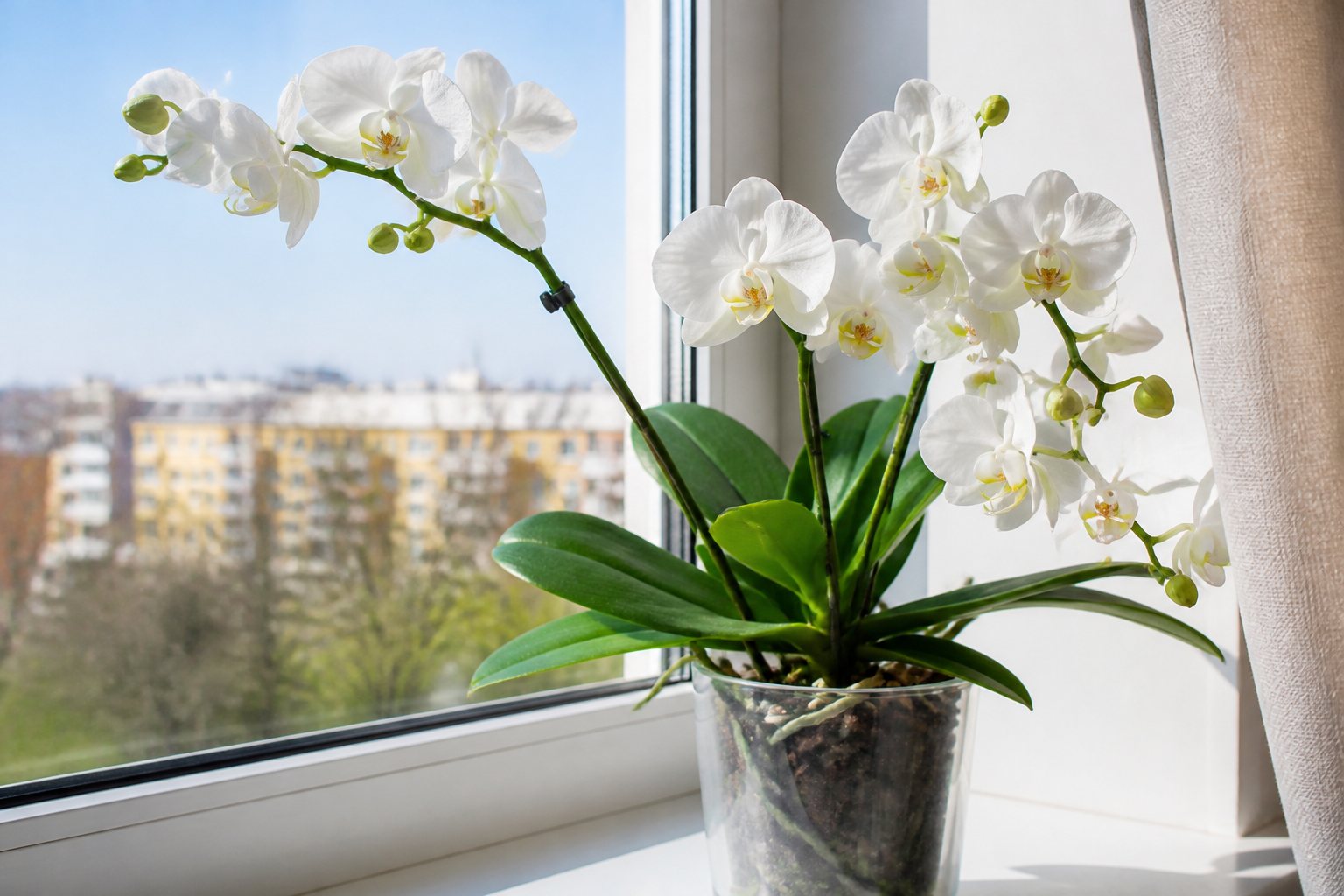

The moth orchid, Phalaenopsis, is sold in every supermarket and garden centre, and most of them are thrown away once the flowers drop. That is a pity, because it is one of the most forgiving flowering houseplants. With the right watering and a cooler spell in autumn, the same plant can flower again every year.
Phalaenopsis grows on tree branches in the wild, not in soil. Its thick roots cling to bark, get soaked by rain and then dry quickly in moving air. Almost every rule of orchid care at home follows from that.
Below is what it needs on a British windowsill, from watering and bark to the spike after flowering and the state of the roots.
A moth orchid wants bright light without hot midday sun, a clear pot of coarse bark and water only when the roots turn silvery. Soak the pot for 10 to 15 minutes, then let it drain completely. Feed weakly. After flowering, cut the spike above a node or leave it. Four to six weeks of nights at 15 to 18 °C in autumn usually trigger a new spike.
Where should an orchid stand in the home?
An east or west facing windowsill is ideal. A south window works if a net curtain softens the sun between May and August, because direct midday sun through glass can scorch the leaves within an afternoon. A north window is usually too dark for the plant to flower again.
The leaves tell you whether the light is right. Medium, slightly olive green is good. Very dark green, floppy leaves mean too little light, while yellowish or reddish patches mean too much. Daytime temperatures of 18 to 25 °C suit it all year.
In winter, move it closer to the glass, but not touching cold panes and never above a radiator.
How often should you water an orchid?
There is no fixed day. In a heated flat a moth orchid typically needs water about once a week in summer and every 10 to 14 days in winter, but the roots decide. In a clear pot you can see them: silvery grey means dry, green means there is still water inside.
The most reliable method is soaking. It wets the bark evenly, which a quick splash from a jug does not. The general principles for watering houseplants apply here too: less often, but thoroughly.
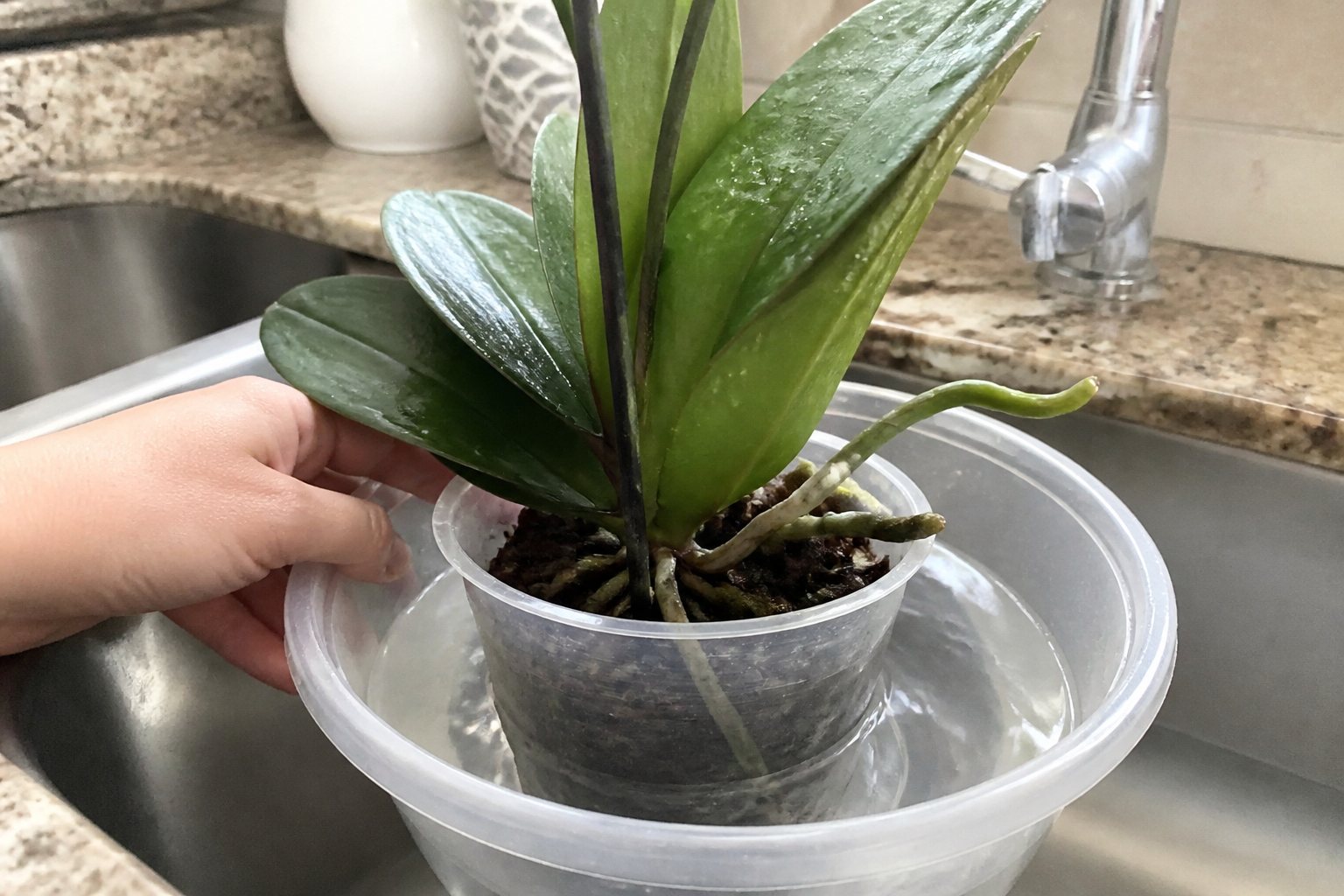
- Fill a bowl or the sink with water at room temperature.
- Stand the clear inner pot in it so the water comes up to just below the rim of the bark.
- Leave it for 10 to 15 minutes, until the roots turn green.
- Lift it out and let it drain for several minutes. No water should remain in the outer pot.
- If water has collected where the leaves join the stem, dab it out with kitchen paper. Water standing in the centre can rot the plant.
Ordinary tap water is fine for most moth orchids. Where it is very hard, as in much of south east England, white crusts form on the bark and roots; then use rainwater or filtered water now and then.
Which compost and pot does an orchid need?
Never ordinary potting compost. A moth orchid needs coarse orchid bark, usually pine pieces of 1 to 2 cm. The gaps let air reach the roots, which matters as much as water.
A clear plastic pot with holes in the base and sides is the practical choice. The roots contain chlorophyll and can use some light, and you can check moisture and root health at a glance.
How do you raise humidity for an orchid?
Moth orchids do best at around 50 to 60 percent humidity. With the heating on, many homes drop to 30 to 40 percent from October to March. A few simple steps help:
- Group the orchid with other houseplants. Together they keep the air around them slightly moister.
- Stand the pot on a tray of expanded clay pebbles with water in it, making sure the pot base sits above the water.
- Avoid misting the flowers and the centre of the plant. Petals spot, and water in the crown encourages rot.
How often should you feed an orchid?
Little and often. Use a liquid orchid fertiliser at half the dose on the label, or less, every second or third watering from spring to autumn. In winter, while the plant is not making new leaves, once a month is enough.
Add the fertiliser to the soaking water, never to bone-dry roots. Soak in plain water once a month to rinse out salts.
What should you do with an orchid after flowering?
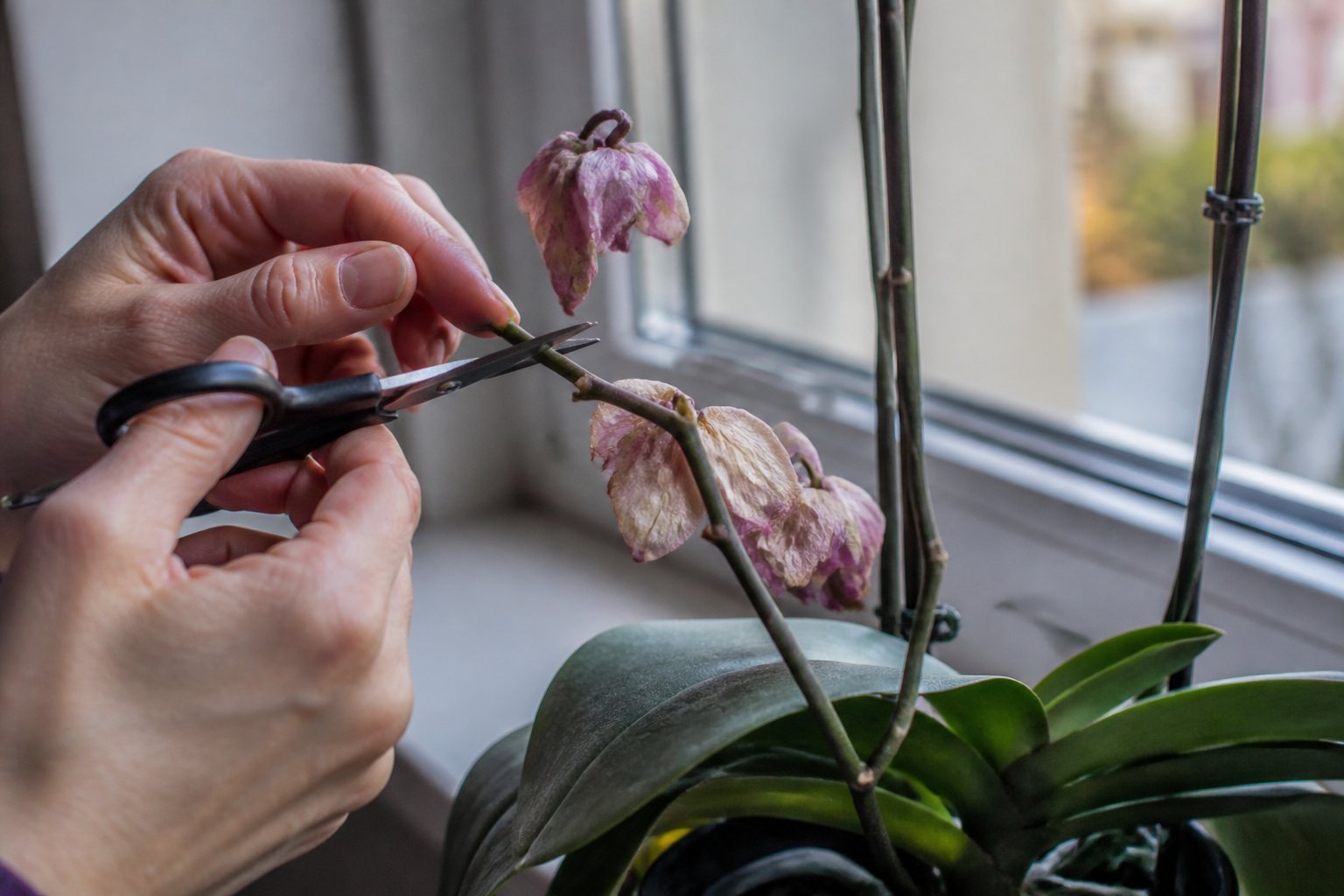
When the last flower drops, look at the spike. If it is brown and dry, cut it off near the base. If it is still green, you have two choices.
- Cut above a node. Count two or three nodes (the small brown bands) up from the base and cut 1 to 2 cm above one. A side branch with a few smaller flowers often follows within two to three months, though not always.
- Leave it. A green spike sometimes produces new buds at the tip or a baby plant (keiki).
- Cut it at the base if the plant has only two or three leaves or looks tired. It will rest, grow roots and leaves, and flower more strongly next season.
How do you get an orchid to flower again?
The trigger is a drop in night temperature. In the wild, cooler nights tell a moth orchid that flowering season is near. At home, about four to six weeks of nights around 15 to 18 °C, with days near 20 to 24 °C, usually start a new spike.
In Britain and central Europe this is easiest in September and October, before the heating comes on fully. A cool bedroom windowsill or a spare room works well.
A new spike looks like a root but has a pointed, mitten-shaped tip. From then on it takes roughly two to three months until the first flower opens.
When and how should you repot an orchid?
Every two to three years, or sooner if the bark has broken down, smells musty or stays wet for days. The best time is just after flowering, when new roots start to grow.
- Ease the plant out of the pot and shake off the old bark. Remove any moss plug often found in supermarket orchids.
- Cut away all brown, mushy or hollow roots with scissors wiped with alcohol.
- Choose a clear pot only 1 to 2 cm wider than the root ball.
- Hold the plant with the base of the leaves at the rim and fill in fresh bark.
- Wait a few days before the first soak, so cut root ends can dry.
How can you tell healthy orchid roots from rotten ones?
| What you see | What it means | What to do |
|---|---|---|
| Silvery grey, firm roots | The plant is dry | Soak for 10 to 15 minutes |
| Green, firm roots | There is still water | Wait a few days and check again |
| Brown, mushy or hollow roots | Root rot, usually from overwatering | Cut them off, repot in fresh bark |
| Wrinkled, limp leaves | Not enough water, often because roots have died | Check the roots, adjust watering |
| Buds turn yellow and drop | Draught, heat or a sudden move | Keep the plant in one steady spot |
| One lowest leaf slowly yellows | Normal ageing | Let it fall off by itself |
Roots growing over the rim are normal.
Can orchids grow together with other houseplants?
Yes, and grouping helps humidity. On very little floor space, use a vertical garden without drilling placed next to a bright window. The Urban Planty vertical garden clamps between floor and ceiling with a telescopic pole, adjusts up to 285 cm and holds nine plants on less than one square metre, so it also suits rented flats.
Its pots each have a 300 ml water reservoir, which suits herbs and small plants, such as many easy houseplants. An orchid, however, should stay in its own clear pot of bark, with no water left standing under the roots.

Frequently asked questions
How often should you water a moth orchid?
A moth orchid usually needs water about once a week in summer and every 10 to 14 days in winter. Water when the roots in the clear pot turn silvery grey, by soaking the pot for 10 to 15 minutes and draining it fully.
Should you cut the orchid spike after flowering?
If the orchid spike is brown, cut it off at the base. If it is green, you can cut 1 to 2 cm above a node for a possible side branch, or leave it; tired plants are better cut back fully.
Why does my orchid not flower again?
An orchid usually fails to flower again because it gets too little light or the nights are too warm. Four to six weeks of nights at 15 to 18 °C in autumn, on a bright windowsill, normally trigger a new spike.
Can you plant an orchid in normal potting compost?
No. A moth orchid needs coarse orchid bark; in ordinary compost the roots get no air and soon start to rot.
What do healthy orchid roots look like?
Healthy orchid roots are firm and silvery grey when dry, green when wet. Brown, mushy or hollow roots are rotten and should be cut off.