EN
 Italiano
 Slovenščina
 Čeština
 Deutsch
 Magyar
 polski
 Slovenčina


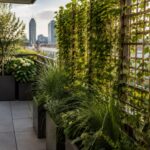

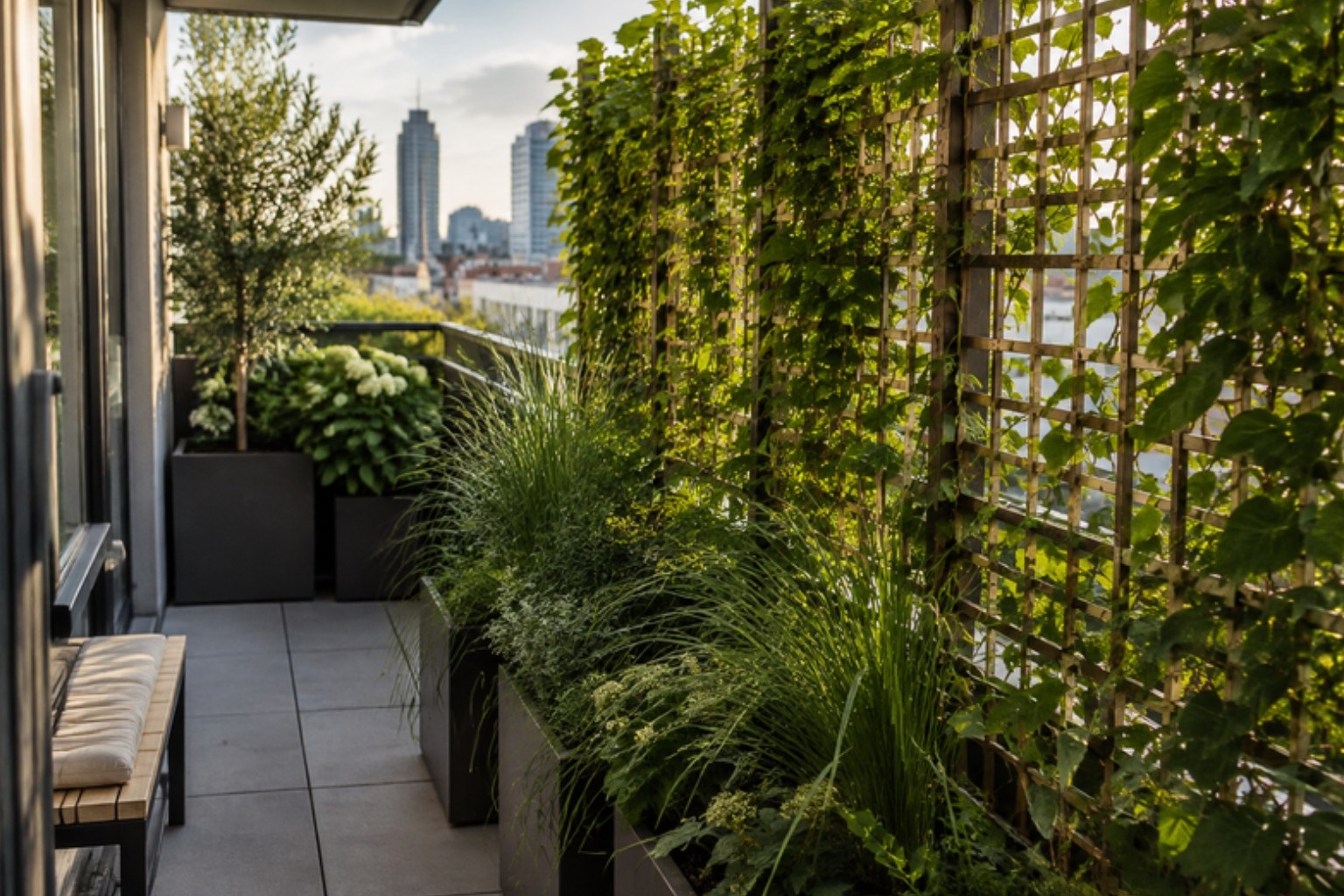

A green screen on a balcony blocks the view from the street and the flats opposite, softens noise and makes a small space feel like a room. Plants can do it in a single season if they suit the pot and the wind.
Annual climbers cover a trellis by midsummer and disappear in autumn; evergreens screen all year but grow slowly and cost more.
Below: which climbers, grasses and evergreens work in containers, how to set up trellis and planters, what to consider on upper floors, and what neighbours and house rules expect.
For quick privacy on a balcony, sow runner beans or morning glory in May; they reach 2 to 3 m by midsummer. For a screen that returns every year, use clematis, honeysuckle or ivy on a trellis, or tall miscanthus grass. For year-round cover, choose yew or thuja, both toxic if eaten. Use large, heavy planters and secure everything against wind.
Which climbers give fast privacy in pots?
Climbers take up little floor space and grow upwards, which makes them ideal for narrow balconies. They need a trellis, wires or a frame to climb.
- Runner beans (annual): sown in pots in mid to late May, they climb 2 to 3 m, flower red or white and give beans from July. Beans must be cooked before eating.
- Morning glory (annual): sown in May, reaches 2 to 3 m with blue or purple flowers that open in the morning. The seeds are toxic, so keep them away from children and pets.
- Clematis (perennial): needs a pot at least 40 cm deep and wide, shaded roots and its head in the sun. Most types lose their leaves in winter.
- Honeysuckle (perennial): Lonicera henryi keeps much of its foliage in mild winters; Lonicera periclymenum is deciduous but strongly scented in the evening. The berries are not edible.
- Ivy (perennial, evergreen): the best choice for shade and screens all year, but slow in the first year. It is toxic to cats and dogs, and its aerial roots can damage plaster, so keep it on a trellis away from the wall.
Which tall grasses and bamboo work on a balcony?
Chinese silver grass (Miscanthus sinensis) is one of the most useful screening plants for large containers. It reaches 1.5 to 2 m or more and tolerates sun and heat. The leaves turn straw-coloured in winter but the stems stay standing until you cut them back in late February or March. New growth reaches full height again by early summer, so there is a gap in spring.
Bamboo gives an evergreen screen, but only in a sturdy, straight-sided container of at least 50 litres. Choose a clumping type such as Fargesia, not a running bamboo, whose rhizomes can split pots. Bamboo needs plenty of water, including on frost-free winter days.
Which evergreens give year-round privacy, and are they toxic?
Yew (Taxus baccata) and thuja (Thuja occidentalis, for example the narrow variety ‘Smaragd’) form dense green walls in planters and can be trimmed.
Both are toxic. In yew, every part except the red flesh around the seed is highly poisonous to people and animals, so it does not belong on a balcony where small children or pets chew plants. Thuja contains thujone, is harmful if eaten and its sap can irritate the skin; wear gloves when pruning.
Evergreens in pots suffer most from drought in winter: frozen compost and sun or wind dry the foliage while roots cannot take up water. Water them on frost-free days from November to March.
| Plant | Type | Height in a pot | Privacy |
|---|---|---|---|
| Runner beans | Annual climber | 2 to 3 m | July to October |
| Morning glory | Annual climber | 2 to 3 m | July to October |
| Clematis | Perennial climber | 1.5 to 3 m | May to October |
| Honeysuckle | Perennial climber | 2 to 3 m | Spring to autumn, partly in winter |
| Ivy | Evergreen climber | Slow, up to 3 m | All year |
| Miscanthus | Grass | 1.5 to 2 m or more | June to February |
| Bamboo (Fargesia) | Evergreen grass | 1.5 to 2.5 m | All year |
| Yew, thuja | Evergreen shrub | 1 to 2 m | All year |
What trellis and planters are best for a balcony screen?
The most stable solution is a long planter with a built-in trellis: the weight of the compost holds the frame upright, and nothing needs to be drilled. A box 80 to 100 cm long and at least 30 cm deep suits two or three climbers or one large grass.
Trellis panels can also be tied to the inside of the railing with cable ties or clamps. Wet compost is heavy, and a large planter can weigh several tens of kilograms, so if you plan several, ask the building management about the balcony’s load limit.
What should you consider on upper floors with strong wind?
From about the fourth floor upwards, wind becomes the main problem. A dense screen acts like a sail and can tip over light planters or tear a trellis loose. Use heavy, wide containers, fix every trellis at several points and choose plants that tolerate wind, such as miscanthus, ivy or yew.
Never place pots on the railing or on the outside of it; the risk of something falling is too high. More on planting a small space is in our article on small balcony garden ideas.
How much light do plants take from you and your neighbours?
A dense 2 m screen along the whole railing also shades the balcony and the room behind it. Screen only the side that is overlooked, or use lighter plants such as grasses that let some light through.
Think of the neighbours as well. Tall plants at the side can shade their balcony, and water from saucers or falling leaves should not land on the balcony below. If your balcony is shady, see our list of plants for a shady balcony; for full sun, plants for a sunny balcony.
What do house rules usually say about balcony screens?
In flats, drilling into the wall or fixing a permanent screen that changes the look of the building usually requires the consent of the landlord or the owners’ association. Plants in planters, free-standing frames and trellis tied to the railing from the inside are generally accepted. Check the house rules before buying anything large.
How does a vertical garden fit into a privacy screen?

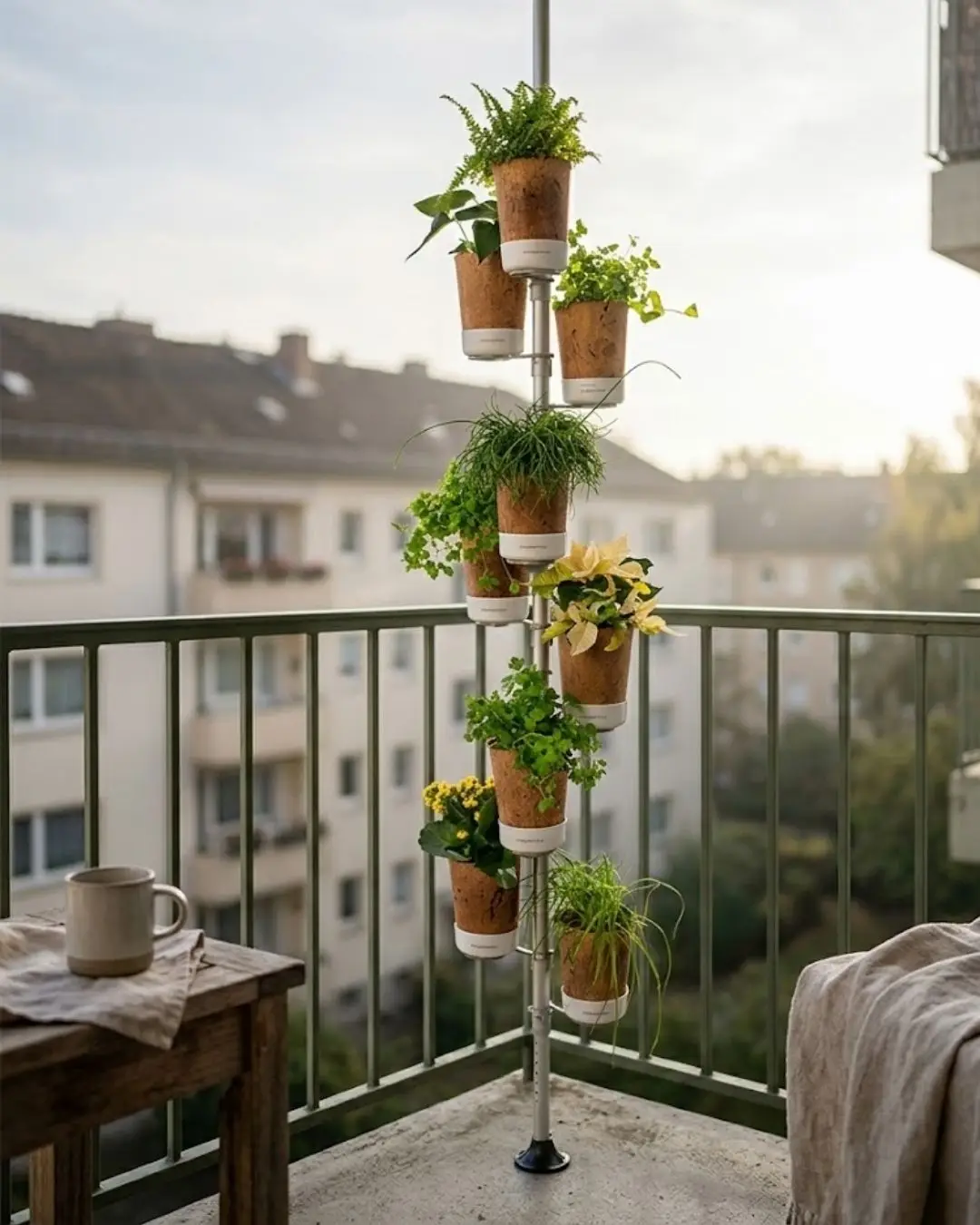
Next to the tall plants, a vertical column of herbs or flowers fills a corner without taking floor space. The Urban Planty Vertical Garden holds nine pots on a telescopic pole clamped between the balcony floor and the ceiling, each with a 300 ml water reservoir, on less than one square metre and without drilling. It costs €149 with free shipping. More about the vertical garden without drilling.
Frequently asked questions
What is the fastest-growing privacy plant for a balcony?
The fastest privacy plants for a balcony are annual climbers such as runner beans and morning glory. Sown in May, they reach 2 to 3 m on a trellis by midsummer.
Which privacy plants for a balcony stay green in winter?
Ivy, yew, thuja and clumping bamboo such as Fargesia stay green in winter on a balcony. In pots they need watering on frost-free days so they do not dry out.
Are yew and thuja safe on a balcony with children or pets?
Yew is highly poisonous to people and animals in all parts except the red flesh around the seed, and thuja is harmful if eaten. Neither is a good choice where small children or pets chew plants.
Do I need permission for a privacy screen on my balcony?
A privacy screen fixed to the façade usually needs consent from the landlord or owners’ association. Plants in planters and trellis tied to the railing from inside are generally allowed; check your house rules.