EN
 Italiano
 Slovenščina
 Čeština
 Deutsch
 Magyar
 polski
 Slovenčina









Pothos, or devil’s ivy (Epipremnum aureum), is one of the few houseplants that copes with a British winter indoors without sulking. It tolerates a dim corner, forgives the odd missed watering and roots in a glass of water within weeks. What it does not forgive is a pot that stays wet.
With reasonable light a pothos puts on 30 to 50 cm of growth a year, and after a few seasons the vines can reach the floor from the top of a bookcase.
Pothos care comes down to bright, indirect light, watering only when the top 2 to 3 cm of compost is dry, and a room that stays above 15 °C. Feed every two to four weeks from April to September. Prune just above a leaf joint to make it bushier, root cuttings in water, and keep it away from cats and dogs, as it is toxic to them.
How much light does a pothos need?
A pothos grows best in bright, indirect light: an east or west window, or a metre or two back from a south-facing one. Direct midday sun through glass in June and July can bleach or scorch the leaves, so a sheer curtain helps in a south window.
It will survive in a north-facing room, which is why it appears on every list of low light houseplants. The trade-off is slower growth, smaller leaves, longer gaps between them and less variegation.
From November to February light indoors is weak, so move the plant closer to the window for the winter. It likes the same temperatures you do, ideally 18 to 24 °C. Below about 15 °C growth almost stops, and below 10 °C the leaves can be damaged, so keep it away from cold draughts and single-glazed windows.
How often should you water a pothos?
Water thoroughly when the top 2 to 3 cm of compost feels dry, until it runs out of the drainage hole, and empty the saucer after 15 minutes. In a warm room in summer that usually means once a week; in winter, every two to three weeks.
There is no fixed schedule: a plastic pot dries more slowly than terracotta, and a plant by a radiator faster than one on a cool landing. Slightly limp leaves mean it is ready for a drink.
Compost, pot and feeding
Use peat-free houseplant compost with some perlite, in a pot with a drainage hole. Repot in spring when roots poke out of the hole, moving up only 2 to 4 cm in diameter.
From April to September feed every two to four weeks with a liquid houseplant fertiliser at half the strength on the bottle. Stop from October to March, when the plant barely grows.
Trailing or climbing: which is better for a pothos?
Both work. In the wild pothos climbs tree trunks with aerial roots, and its leaves grow much larger as it climbs. Indoors, a plant trained up a moss or coir pole usually makes bigger leaves than one left to hang, though the split leaves of the wild plant are rare in a home.
Trailing is easier and suits shelves or a hanging pot, but the leaves stay small and the top of the pot can thin out. Tie climbing stems loosely to the pole so the aerial roots can grip it.
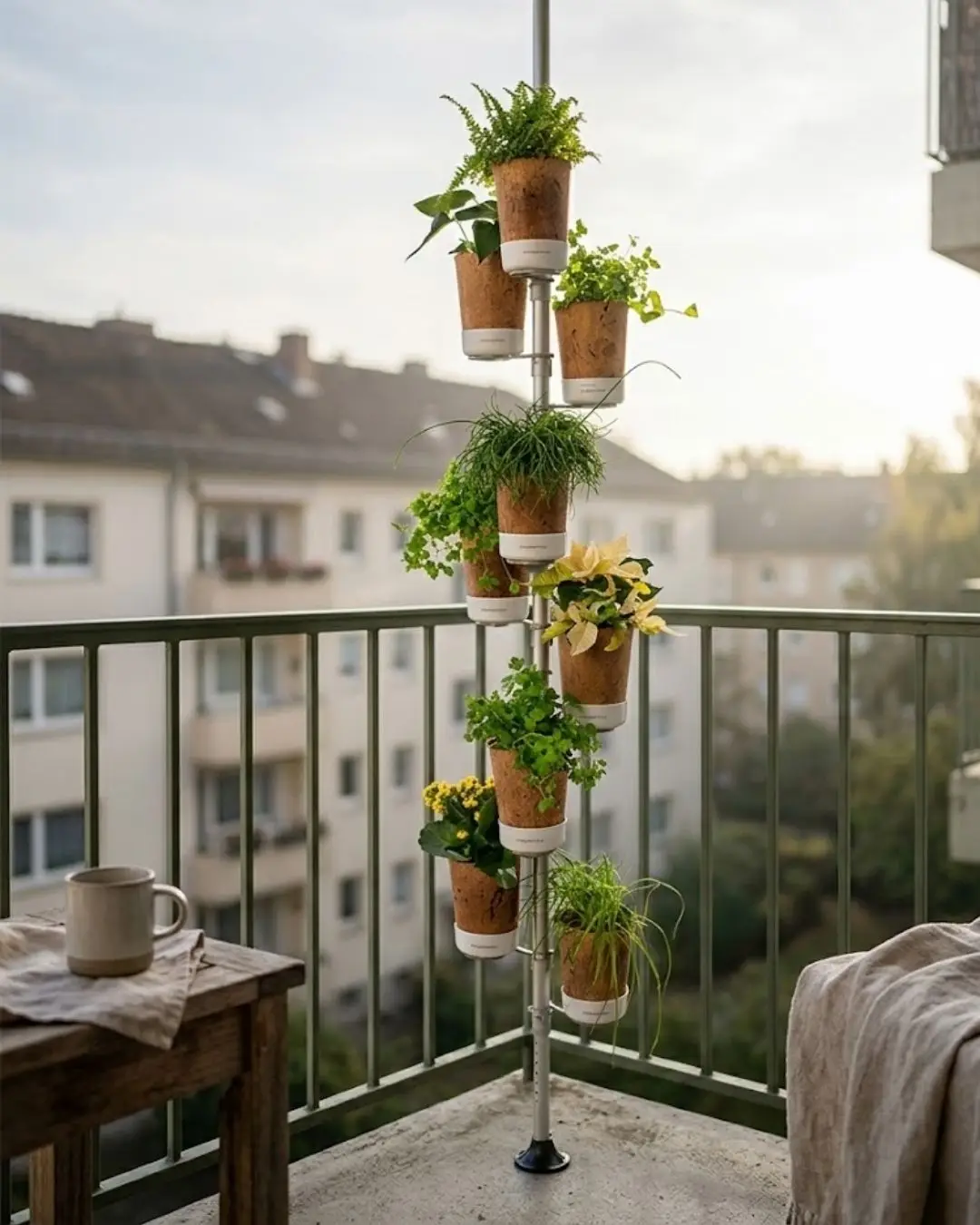
Pothos also does well in a vertical garden without drilling next to a window, where the vines can hang down past the pots below. The Urban Planty Vertical Garden clamps between floor and ceiling on a telescopic pole and holds nine plants on less than a square metre; each pot has a 300 ml water reservoir. It costs €149 with free delivery.
How do you prune a pothos to make it bushier?
Pothos branches little on its own: a vine keeps extending from the tip while the older part loses leaves. Cutting it back makes the plant push out new shoots from the leaf joints, or nodes, below the cut. Spring and early summer are best, but a light trim is fine at any time.
- Use clean, sharp scissors or secateurs. The sap can irritate sensitive skin, so gloves are sensible.
- Cut about 1 cm above a node, the small bump where a leaf meets the stem. Below it, one new shoot usually appears within a few weeks.
- Shorten a few of the longest vines by a third to a half rather than cutting everything at once.
- Pinch out the growing tips of the remaining vines every few weeks in summer to encourage side shoots.
- Root the pieces you cut off and plant them back into the same pot. This is the quickest way to fill out a thin plant.
How do you propagate pothos in water?
Pothos is one of the easiest plants to root. Every cutting needs at least one node, because that is where roots grow from; a leaf with only its stalk never becomes a plant.
- Cut pieces 10 to 15 cm long with two or three nodes.
- Remove the lowest leaf so that its node can sit under water without a leaf rotting in the glass.
- Put the cuttings in a jar or bottle of room-temperature tap water, in bright light but out of direct sun.
- Change the water every week, or sooner if it turns cloudy.
- Pot them into compost when the roots are 3 to 5 cm long, and keep the compost slightly moist for the first two weeks while the roots adjust.
In a warm room the first roots usually appear within two to four weeks; in winter it can take twice as long.
Why are my pothos leaves turning yellow?
One yellow leaf at the base of an old vine is normal ageing. Several at once point to a problem, and the pattern usually shows which.
| What you see | Likely cause | What to do |
|---|---|---|
| Several lower leaves yellow and soft, compost wet | Overwatering, possibly root rot | Let it dry out; check the roots and cut off brown, mushy ones; repot in fresh compost |
| Yellow leaves with dry brown edges, compost shrunk from the pot | Too dry for too long | Soak the pot for 20 minutes, then water regularly |
| Pale leaves, long bare stems, variegation fading | Too little light | Move closer to a window, especially in winter |
| Yellow or brown patches on the side facing the glass | Sunburn | Move out of direct midday sun or add a sheer curtain |
| Yellowing after a cold spell or near an open window | Cold or draughts below about 10 °C | Move to a warmer spot; damaged leaves will not recover |
| Overall pale yellowing, no repotting for years | Lack of nutrients or rootbound | Feed from spring; repot one size up |
Yellow leaves do not turn green again, so remove them once you have found the cause. Overwatering is by far the most frequent culprit, and our guide on how to water houseplants explains how to judge when a pot really needs water.
Which pothos varieties are there?
All the varieties below are Epipremnum aureum and need the same care. The paler the leaf, the more light the plant needs and the slower it grows.
- Golden pothos: green leaves with yellow streaks. The most common and most robust, the best choice for a darker room.
- Marble Queen: leaves heavily marbled with cream and white. Grows more slowly and needs brighter light to keep its pattern.
- Neon: bright lime-green leaves without variegation. In low light the colour turns duller and darker.
- N’Joy: a compact variety with smaller leaves and clearly separated white and green patches. Slow, and best in a bright spot.
Is pothos toxic to cats and dogs?
Yes. All parts contain calcium oxalate crystals. A cat or dog that chews the leaves typically gets a burning mouth, drools, paws at its face, vomits or struggles to swallow. Serious poisoning is rare, but call your vet if you see symptoms.
The same applies to small children: if a child has chewed a leaf, rinse the mouth and call NHS 111 for advice. With a cat that climbs, choose a room it cannot reach, or a different plant.
Frequently asked questions
How often should I water a pothos?
Water a pothos when the top 2 to 3 cm of compost is dry, typically about once a week in summer and every two to three weeks in winter.
Can a pothos grow in a room without much light?
A pothos survives in a north-facing room, but it grows slowly, the leaves stay small and variegated varieties lose their pattern.
Why is my pothos getting yellow leaves?
The most common cause of yellow pothos leaves is overwatering, especially in winter. Other causes are a pot left dry for too long, too little light, cold draughts and, for one old leaf at the base, normal ageing.
How long does it take pothos cuttings to root in water?
Pothos cuttings with at least one node under water usually root in two to four weeks in a warm room, and more slowly in winter.
Is pothos poisonous to cats and dogs?
Yes, pothos contains calcium oxalate crystals that irritate the mouth and throat of cats and dogs, causing drooling and vomiting. Keep it out of reach and contact a vet if a pet has chewed it.