EN
 Italiano
 Slovenščina
 Čeština
 Deutsch
 Magyar
 polski
 Slovenčina







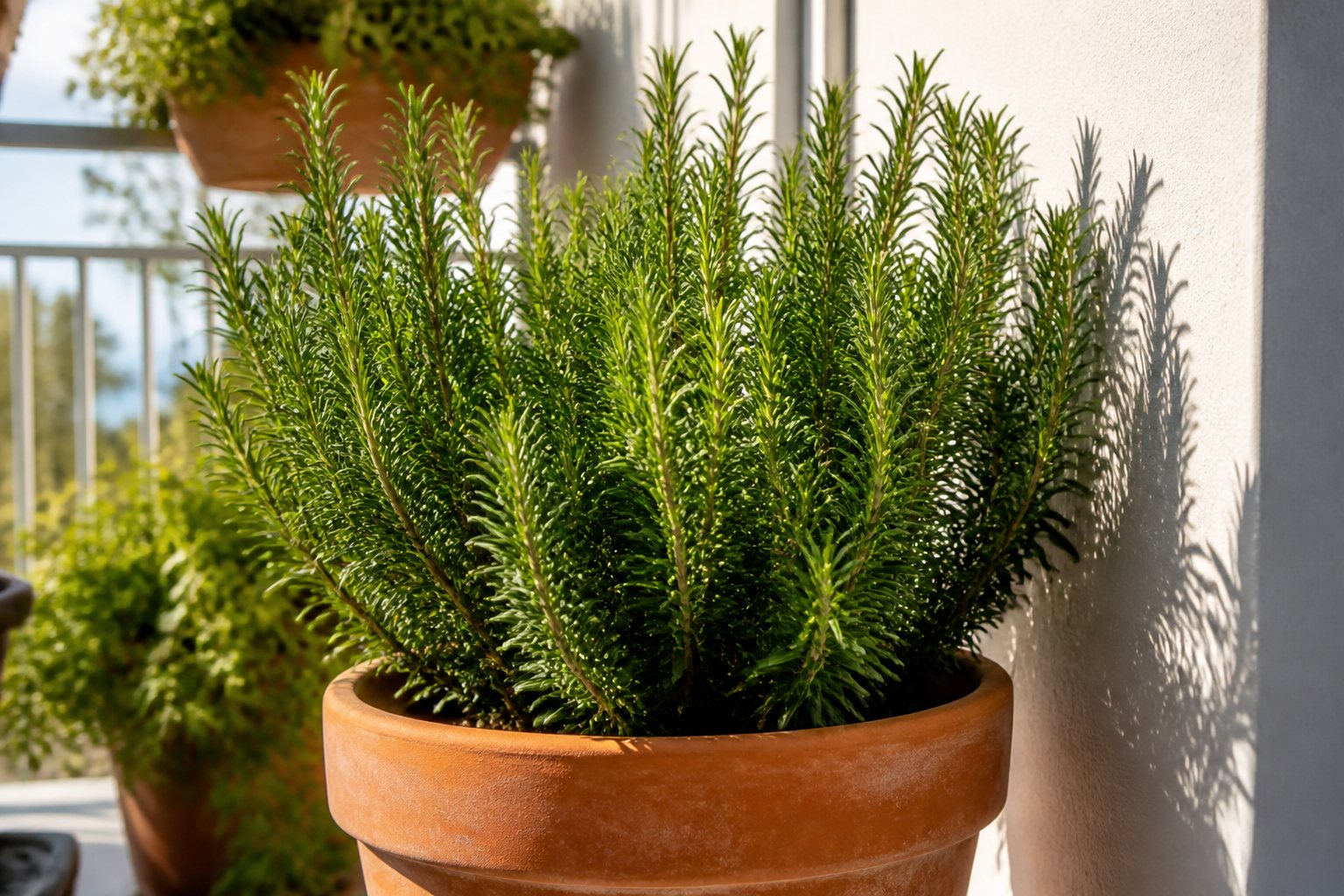

Rosemary bought in spring often looks fine all summer and then fails between November and March. In most cases the cause is not cold alone but compost that stays wet, a warm room with dry air, or a root ball left frozen in a small pot.
Rosemary is a shrub from the dry, rocky coasts of the Mediterranean. Botanists now call it Salvia rosmarinus, though most labels still say Rosmarinus officinalis. It wants strong sun, a lean mix that drains fast, and a cool, bright winter.
Rosemary in pots needs at least six hours of direct sun, a terracotta pot with drainage holes and a gritty compost. Water thoroughly, then wait until the top few centimetres are dry, but never let the root ball dry out completely. Prune only into leafy growth. In most of central Europe, overwinter it in a bright, cool place at 5–10 °C.
How much sun does rosemary need?
As much as you can give it. Six to eight hours of direct sun a day is the minimum for compact, aromatic growth, so a south or west-facing balcony is ideal. On an east-facing balcony it grows, but more slowly and more loosely.
What pot and compost does rosemary need?
Terracotta is the best choice. Unglazed clay lets moisture evaporate through the sides, so the root zone dries faster after watering.
Drainage holes are not negotiable. Do not stand the pot in a cachepot or a saucer that holds water; tip out any water that collects within 15 minutes of watering.
For a young plant from a 9–12 cm nursery pot, use a pot of 20–25 cm. A mature shrub is happy in 30–40 cm.
For the mix, combine roughly two parts peat-free multipurpose or loam-based compost (John Innes No. 2 is good) with one part horticultural grit or fine gravel of 2–5 mm. Rosemary prefers neutral to slightly alkaline soil, so avoid ericaceous compost.
How often should you water rosemary in a pot?
Rosemary dies from wet roots far more often than from thirst. In compost that stays soggy the fine roots suffocate and rot, and the plant turns grey and brittle even though the pot is damp.
Water thoroughly until water runs out of the drainage holes, then wait until the top 3–4 cm feel dry. In a July heatwave that can mean every two or three days in terracotta; in a cool spring, once a week or less.
There is one important exception. Rosemary does not show thirst by wilting as basil does, and if the whole root ball dries out completely the needles drop weeks later and the plant rarely recovers. So: let it dry at the surface, but not all the way through.
For more on reading compost moisture, see our guide how to water houseplants.
Does rosemary need feeding?
Very little. Fresh compost after repotting is enough for a season. Otherwise give a liquid herb or vegetable feed at half strength once a month from April to August. Stop in late summer.
How to harvest rosemary without weakening the plant
You can cut rosemary all year round, but most freely from spring to early autumn, when the plant is growing. Cut sprigs of 10–15 cm from the tips, just above a pair of leaves, with clean scissors or secateurs.
Never take more than a third of the plant at once, and always leave green, leafy growth below the cut.
When and how should you prune rosemary?
The best time is right after flowering, usually in April or May.
Shorten the shoots by a third at most and shape the plant into a loose dome. The key rule is the same as for lavender: do not cut back into old, bare wood. Rosemary rarely sprouts from leafless stems, so a hard cut can leave permanent gaps.
Avoid heavy pruning from September onwards. Soft regrowth does not ripen before winter.
Can rosemary in a pot stay outside in winter?
It depends on the variety and on where you live. Most ordinary rosemary tolerates brief frosts of about -5 to -10 °C, if the plant is dry and well established. Varieties sold as hardier, such as ‘Arp’ and ‘Veitshöchheim’, can survive around -15 °C in the ground in a dry, sheltered spot.
A pot changes things. The roots are exposed on all sides and freeze much sooner than in the ground. There is also frost drought: on sunny winter days the leaves lose water while the frozen roots cannot take any up.
In mild coastal and urban gardens, and in the south of England, a hardy variety can often stay outside in a large pot. In colder inland areas and across most of central Europe, where -15 °C is not unusual, bringing it in is the safer choice.
| Winter option | Temperature | Suitable for | Watering |
|---|---|---|---|
| Bright, cool room (unheated stairwell, cool bedroom, unheated conservatory) | 5–10 °C | all varieties, the safest choice | sparingly, every 1–3 weeks, root ball never fully dry |
| Sheltered outdoor spot by a house wall, pot wrapped | down to about -10 °C (hardy varieties a little lower) | hardy varieties in mild areas | only on frost-free days, when compost is dry |
| Warm living room | over 18 °C | an emergency solution only | more often, but no standing water |
| Dark garage or cellar | 0–5 °C | not recommended; rosemary is evergreen and needs light | n/a |
How to overwinter rosemary indoors
Bring the pot in during late October or November, to the brightest cool spot you have. Water only enough to keep the root ball from drying out: in a cool room that is usually every one to three weeks. Do not feed in winter.
If rosemary has to stay outside
- Move the pot against a house wall, under the eaves, where rain does not reach it.
- Stand it on wood or polystyrene and wrap the pot in bubble wrap, hessian or a double layer of fleece.
- In hard frost or strong sun, drape fleece loosely over the plant and remove it when the weather eases.
- Water only on frost-free days, and only when the compost is dry.
In spring, after the last hard frosts, move indoor rosemary out gradually: first a few days in light shade, then full sun. Leaves used to a window scorch easily.
Why does rosemary get powdery mildew indoors?
A white, floury coating on the needles is powdery mildew. It usually appears on rosemary kept indoors in warm, still air with too little light, a common situation in a heated living room in January.
Cut off badly affected shoots and move the plant somewhere cooler and brighter. Ventilate the room regularly and leave space between pots so air can move. Do not mist the leaves.
When should you repot rosemary?
Repot every two to three years in spring, in March or April, when roots fill the pot or grow out of the drainage holes. Go up only one size, about 5 cm wider. A pot that is far too big holds more wet compost than the roots can use.
How to propagate rosemary from cuttings
- Timing: late spring to late summer, from healthy, non-flowering shoots.
- Cutting: take tips of 8–10 cm and strip the needles from the lower half.
- Planting: push them 3–4 cm deep into a mix of half compost and half sand or perlite, several to a small pot.
- Care: keep them bright but out of direct sun and the mix lightly moist, never wet. A clear bag over the pot helps; air it daily.
- Rooting: roots usually form within four to eight weeks. New growth at the tip is the sign to pot them up singly.
What to grow beside rosemary on a small balcony
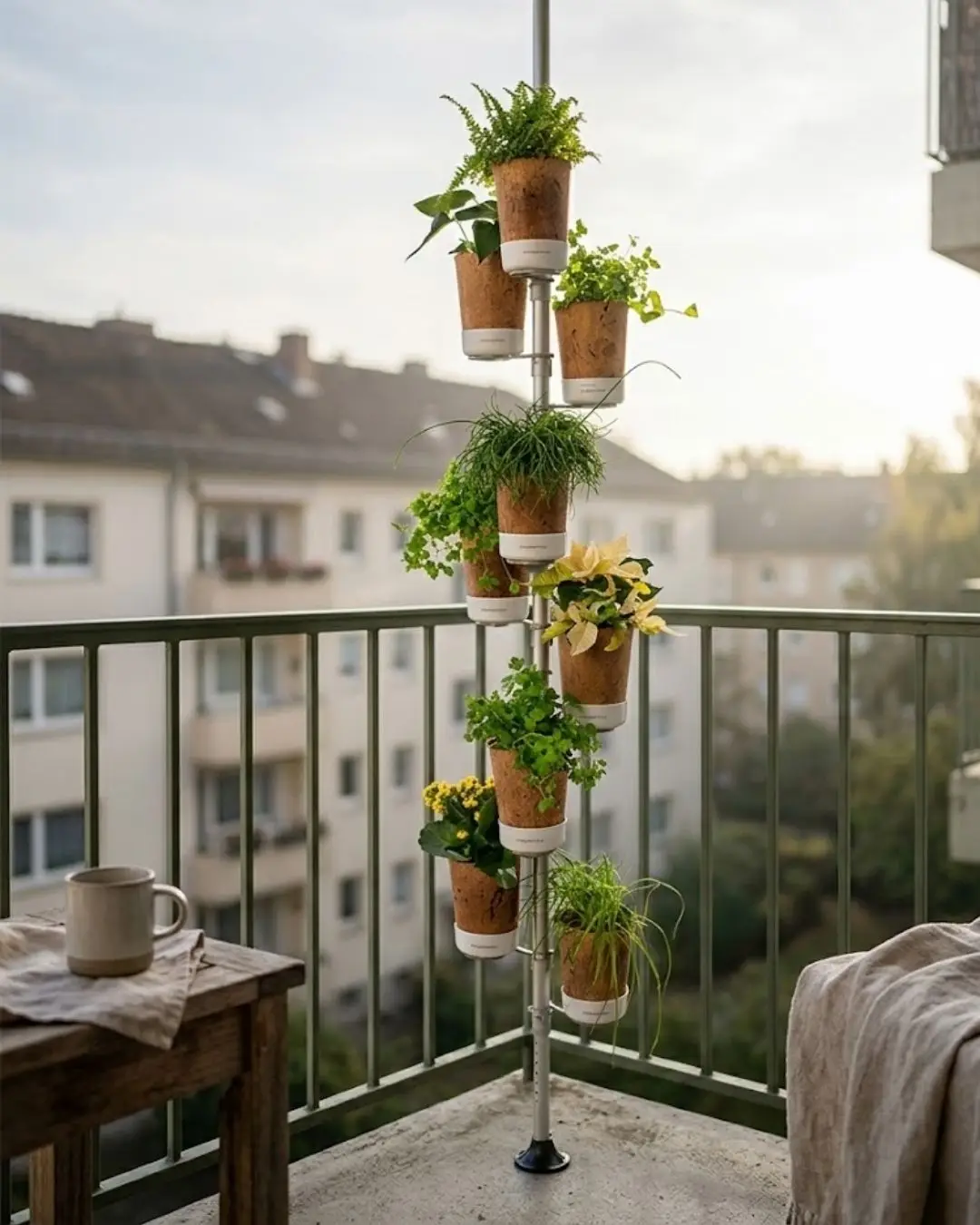
Rosemary is happiest in its own clay pot in full sun. Herbs that like evenly moist compost, such as basil, parsley and chives, can go upwards instead, for example in the Urban Planty vertical garden: nine pots with a 300 ml water reservoir each on less than 1 m² of floor. Its telescopic pole clamps between floor and ceiling, so this vertical garden without drilling suits rented flats too. It costs €149 with free shipping. For more combinations, see our balcony herb garden guide.
Frequently asked questions
Can rosemary in a pot stay outside over winter?
Rosemary in a pot can stay outside only in mild areas, and preferably a hardy variety such as ‘Arp’ or ‘Veitshöchheim’, sheltered from rain with the pot wrapped. In most of central Europe it is safer to overwinter rosemary in a bright place at 5–10 °C.
How often should I water rosemary in a pot?
Water potted rosemary thoroughly when the top 3–4 cm of compost are dry, which can be every two to three days in summer heat and every one to three weeks in a cool winter room. Never leave water in the saucer, and never let the root ball dry out completely.
Why is my rosemary turning brown or dropping needles?
Rosemary usually browns from waterlogged roots, a root ball that dried out completely, or a winter spot that is too warm and too dark.
Can I cut rosemary back hard?
Rosemary should not be cut back into old, leafless wood, because it rarely regrows from bare stems. Shorten shoots by a third at most, ideally just after flowering in spring.
How do I get rid of white mildew on indoor rosemary?
The white coating on indoor rosemary is powdery mildew, encouraged by warmth, still air and low light. Remove the affected shoots, move the plant somewhere cooler and brighter, and ventilate the room regularly.